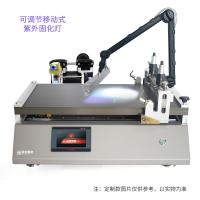
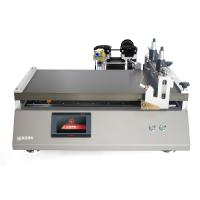
Lab Film Applicator ITO and AZO transparent conductive film prepative
Introduction
Transparent conductive films play a key role in many modern technology fields, including display devices, touch panels, photovoltaic cells, and energy-efficient windows. Among many materials, indium tin oxide and zinc oxide aluminum have become mainstream choices due to their good conductivity and high light transmittance. Laboratory-scale film preparation is the basic link of material research and process development, among which film coating machine, as an important wet preparation equipment, provides an effective way to achieve high-quality and reproducible film sample preparation.
How it works
Laboratory film coating machines mainly mechanically apply pre-prepared solutions or slurries evenly on the substrate surface, and then heat treat them to form solid films. Its core process consists of three stages: coating, leveling and drying. During the coating phase, a wet film is formed on the substrate by controlling the gap and movement speed of the scraper or winding rod. In the leveling stage, the liquid tends to form a uniform liquid layer under the action of surface tension. During the drying stage, the solvent is volatilized by heating, and the precursors decompose or react, eventually forming a dense film. Controllability of the entire process is the basis for achieving the desired film thickness and uniformity.
Precursor solution preparation
The preparation of high-quality films is premised on obtaining a stable and homogeneous precursor solution. For ITO films, indium salts and tin salts are usually used as raw materials, dissolved in specific solvents (such as alcohols), and stabilizers are added to obtain a uniform and transparent sol through stirring and aging. For AZO films, zinc salts and aluminum salts are used as precursors and prepared in a similar process. The concentration, viscosity, surface tension and pH value of the solution have a direct impact on the quality of the final coating film. There is an approximate relationship between concentration c and the final dry film thickness d, which can be expressed as: d = k * c * h, where h is the wet film thickness and k is the constant related to the density and shrinkage of the material. Therefore, precise solution formulation is the first step.
Parameter optimization
When using the coating machine to prepare films, multiple process parameters need to be systematically optimized. The main variables include coating speed, scraper clearance, substrate temperature, and subsequent heat treatment conditions. The coating speed affects the thickness and shear force of the wet film, which in turn affects the molecular orientation. The scraper gap directly determines the physical thickness of the wet film. The base temperature affects the initial volatilization rate of the solvent, which plays an important role in the leveling and defect formation of the film. These parameters need to be co-optimized through experimental design to achieve the desired film uniformity and performance.
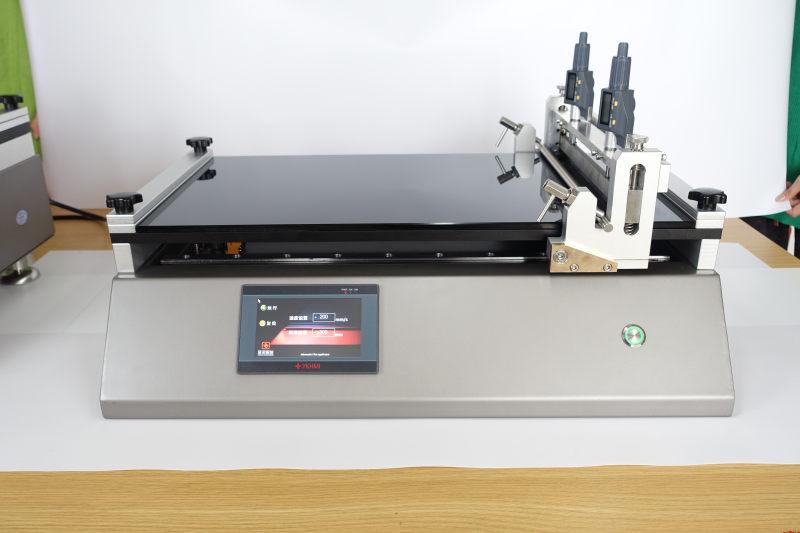
The following is an overview of the key process parameters and their impacts:
| Process parameters | Main impact |
| Coating speed | affect the thickness and uniformity of the wet film; Too fast can cause streaks, and too slow can cause excessive drag. |
| Scraper gap | The theoretical thickness of the wet film should be directly controlled to match the viscosity of the solution. |
| Basal temperature | Adjust the initial rate of solvent volatilization, and too high a temperature may cause cracks to dry too quickly. |
| Heat treatment procedures | Determines the crystallinity, density and electrical properties of the final film. |
Heat treatment and film properties
The wet film formed by coating is converted into a solid film with functional properties through heat treatment. Heat treatment typically consists of two stages: low-temperature drying to remove most of the solvent, and high-temperature annealing to allow the precursors to decompose, oxidize, and crystallize. For ITO and AZO films, annealing temperature, heating rate, holding time, and atmosphere (e.g., air or inert gas) are key variables. The annealing process affects the grain size, oxygen vacancy concentration, and doping efficiency of the film, which determines its conductivity and light transmission. The relationship between resistivity ρ and carrier concentration n and mobility μ is given by the formula: ρ = 1/(n e μ), where e is the electron charge. The optimized heat treatment process is designed to improve n and μ while maintaining high light transmission.
Performance characterization methods
The prepared film undergoes a series of characterizations to evaluate whether its performance meets the application requirements. Core performance indicators include film thickness, surface roughness, electrical resistance (or block resistance), optical light transmittance, and structural crystallinity. Common characterization methods include four-probe resistance testers, UV-Vis spectrophotometers, stepmeters, atomic force microscopes, and X-ray diffractometers. Through systematic characterization, the correlation between process parameters and film properties can be established to guide further optimization of the process.
Applications & Challenges
ITO and AZO film samples prepared by the laboratory coating machine provide a material basis for subsequent device development. This method has the advantages of low cost, easy operation, and easy adjustment of ingredients and processes, making it ideal for recipe screening and process window exploration. However, there are also challenges, such as how to steadily scale up the laboratory process to a larger area, how to further reduce the film resistance while maintaining high light transmission, and how to reduce the sensitivity of the process to the environment. Future work may focus on developing new precursors, optimizing multi-layer coating processes, and integrating in-situ monitoring technologies.
Conclusion
Laboratory film coating machines are an effective tool for the preparation of ITO and AZO transparent conductive films. By carefully designing the precursor solution, precisely controlling the coating process parameters, and optimizing subsequent heat treatment conditions, thin film samples can be obtained with performance that meets the needs of the research. This process combines knowledge of fluid mechanics, materials chemistry, and solid state physics, reflecting the characteristics of multidisciplinary intersection. Systematic process development and rigorous performance characterization are important ways to promote the technological progress of transparent conductive films.
References
International Organization for Standardization. ISO 9277: Determination of the specific surface area of solids by gas adsorption.
American Society for Testing and Materials. ASTM F1711 Standard Guide for Measuring Sheet Resistance of Thin Films.
Journal of Materials Science. Articles on solution-based deposition of transparent conductive oxides.
Thin Solid Films. Research papers on ITO and AZO film properties and processing.
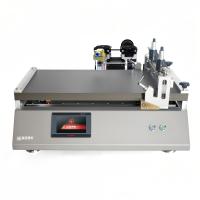

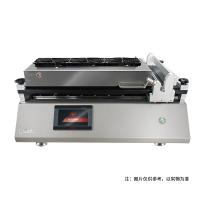


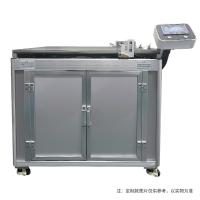
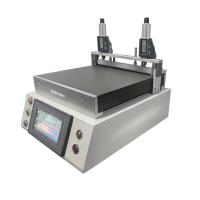
- 1Lab Film Applicator's Magical Use of Silica Gel on Fiber Cloth
- 2Laboratory Film Applicator on Aluminum Foil substrate preparatory suspension
- 3Beginning of coating performance testing: preparatory precision film
- 4HuiNuo TM3300 Film Applicator Measurement | drawdown Bar & Blade film machine with heating vacuum
Xanthe - 《南北潮商城》
- 5Swirl/spinning Film Applicator Suction Cup Surface Residual Glue Cleaning Skills
- 6The Influence of Aluminum Panel on Film Applicator's Accurate film
AIR - 《南北潮商城》
- 7The Influence of Driving System on Film Applicator's Accurate film
AIR - 《南北潮商城》
- 8Effect of Vacuum chuck Aperture on Flatness of Film Applicator Substrate
AIR - 《南北潮商城》
- 9Drawdown Bar & blade Film Applicator Realizes Aluminum Foil Coating Lithium Battery Stock Preparative Electrode Sheet
Xanthe - 《南北潮商城》