Cupping test machine for water-based paint film flexibility
Water-based paint films form through moisture evaporation and resin crosslinking, resulting in coating toughness and interfacial bonding characteristics that differ from traditional solvent-based coatings. Relying solely on bending tests results in differences between the form of force and actual working conditions, making it difficult to intuitively reflect the crack resistance of the paint film under stretch and extension. R&D and Quality Control often use cup-bump testing machines for testing. By using a punch to lift the sample at a constant speed, the depth of stamping when cracks or peeling of the coating is observed, thereby evaluating the coating film's flexibility and comparing its durability under different formulations, film thicknesses, and baking conditions.
The conditions for sample preparation must be strictly standardized. Select substrates with consistent material and thickness, and apply coating according to established processes to stably control the thickness of the dry film. Film thickness is a key factor affecting cupping outcome. Thicker water-based coatings are more prone to cracking during stretching, while larger film thickness deviations are not sufficient for comparison. After coating, the sample is thoroughly cured. The film-forming additives inside the water-based paint have a long evaporation cycle, resulting in insufficient curing, incomplete curing of the paint film, and a low critical depth measured in tests, which cannot represent the true performance of the finished product. Keep the test board surface clean, avoiding areas with bubbles, shrinkage, and sagging. The sample should be flat and free of deformation. After clamping, the warped substrate will bear uneven force, making it prone to premature damage.
Equipment clamping and tooling adjustment require standardized operation. Place the sample flat between the pressure ring and the die, tighten the fixture evenly to prevent slipping during stamping. If the clamping force is insufficient, the sample slips, the punch head shifts under force, and cracks appear in random positions; If clamped too tightly, the substrate will prematurely generate stress, interfering with the test results. Keep the punch surface smooth and clean, free of burrs and impurities. Hard particles pressing the paint film can cause localized stress concentration and premature cracks. In comparative tests of the same batch, the punch's travel speed remained fixed; if the speed was too fast, the impact effect was obvious, making it easy to underestimate the flexibility of the paint film.
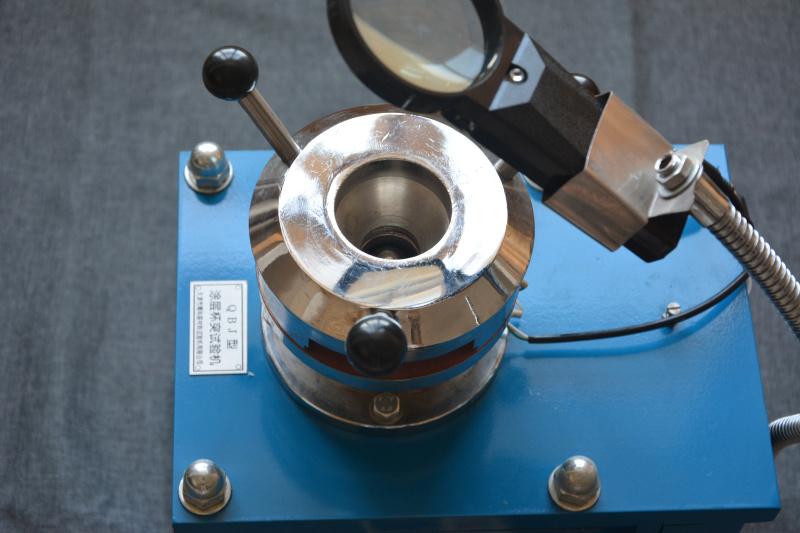
The methods of observation and judgment during tests must be carefully detailed. After starting stamping, continuously observe the coating surface and record the punch stroke values when the paint film first appears with fine lines, cracks, or when the film peels off the substrate. Some water-based systems have good ductility, with fine hairline cracks appearing first without immediate large-scale cracking. Many testers wait until obvious cracking occurs before recording depth, resulting in higher values and evaluation bias. Distinguish between two types of damage: if the paint film is simply cracked, it indicates insufficient toughness of the coating film itself; If cracks accompany peeling and peeling of the paint film, it indicates weak bonding between the coating and the substrate. Try to test each sample only once; after stamping, the substrate may undergo plastic deformation, and the data from the second test is not of reference value.
Routine inspections often encounter issues with data dispersion. Common causes include unconsistent curing durations for sample plates, fluctuating film thickness, uneven clamping tightness of fixtures, and arbitrary changes in stamping speed. Some water-based primers have weak adhesion, and the interface peels off during stamping. Poor toughness of the paint film cannot be judged as a simple matter; a comprehensive analysis combining hundred-grid and draw-out tests is necessary.
Many people have a misconception, thinking that the higher the cup protrusion depth, the better the overall product performance. In practice, it also depends on the product's usage scenario. Some high-hardness water-based paints have limited ductility but can meet working conditions. The core purpose of testing is to compare formula and process differences horizontally, rather than viewing single values in isolation.
Overall, the cup protrusion test can effectively simulate the tensile deformation of paint films, intuitively reflecting the flexibility of water-based paint coating films. By stabilizing sample preparation and curing conditions, standardizing equipment clamping and stamping parameters, and accurately capturing initial cracking points, you can obtain highly repeatable data to guide the selection of water-based paint resins, additive combinations, and construction process optimization.
- 1Water-based paint film test, Cupping test machine is more practical to choose manual or electric
- 2Cupping test for measurement of ductility of Water-based ink coatings
- 3Cupping test of plastic coatings and films Impact ductility
- 4Cupping test machine testing metal coil coating processing forming performance
- 5Cupping test machine to evaluate deformation resistance of automotive steel coatings
- 6Failure analysis of galvanized sheet stamping by cupping testing machine
陈思琪,王雷刚,黄瑶 - 《《基于杯突试验的镀锌板冲压成形失效分析》》
- 7Paint film flexibility bending test, which of these 5 instruments is more suitable?
- 8Cupping Testing Machine Test Coating Cupping Test
- 9Operation method and precautions of cupping instrument