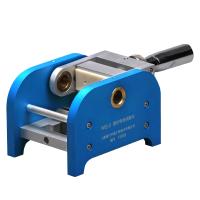
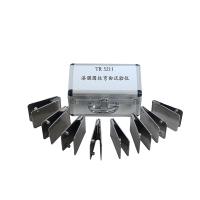
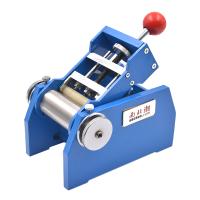
Bending tester for cylindrical mandrel coating
During the service of the ballast tank's water-based heavy anti-corrosion coating, the steel plates of the hull continuously deform under wave loads. The coating must bend and deform along with the substrate. If the toughness is insufficient, cracks and peeling may occur, creating hidden corrosion hazards. Conventional small-diameter cylindrical bending tests find it difficult to simulate the true stress conditions of thick film anti-corrosion coatings. The cylindrical shaft bending tester can select different diameters of bending cores for testing, testing the cracking resistance of the paint film during bending. It is widely used for screening ballast tank coating formulas and verifying film thickness schemes.
Consistency in sample preparation is the prerequisite for comparable test data. The base material is steel plates that closely match the actual project requirements, with unified sandblasting grades and surface roughness. Primer, intermediate, and topcoats are applied according to process requirements, with strict control of the dry film thickness of the entire system. Most ballast tank coatings belong to thick coating systems. Fluctuating film thickness directly affects bending performance. The thicker the film, the greater the tensile stress on the surface during bending, making cracks more likely. After coating, if the sample is thoroughly cured, the moisture and additives inside the water-based anti-corrosion coating evaporate slowly. If curing is inadequate, the paint film cross-linking is incomplete, and the test results will be severely distorted. The test area avoids surface defects such as sagging, pinholes, and bubbles; the sample board surface is smooth and free of pre-bent marks.
Before testing, select the bending core diameter according to the coating technical requirements. The ballast tank coating system often uses multiple specifications of cylindrical shafts for stepwise testing, replacing the bend core from small to large to find the critical diameter where initial cracks appear in the coating. Many people simply select the minimum bend core for one-time judgment, making it difficult to distinguish the toughness range of the coating, which is not conducive to cross-comparison between different formulations. The curved core surface should remain smooth; burrs and rust must be cleaned promptly. Hard raised surfaces squeezing the paint film can easily cause local stress concentration and prematurely trigger cracks.
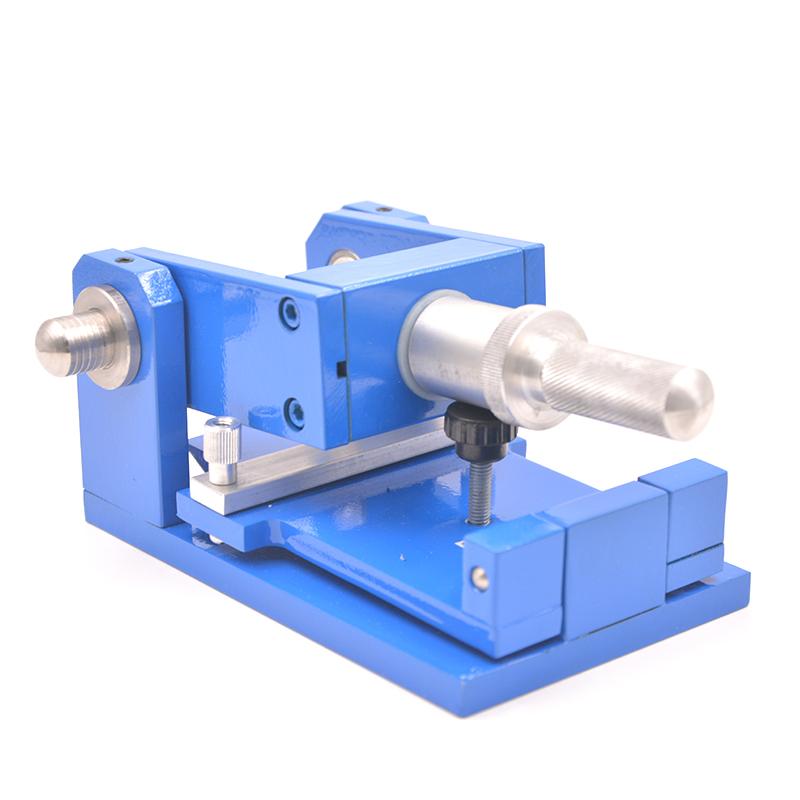
The clamping and bending techniques must be kept consistent. The sample is centered on the instrument stand, with the coating facing outward to ensure the paint film is on the tension side during bending. Pressing should be smooth and steady; do not apply rapid impact, as instantaneous impact forces can generate extra stress and cause abnormal coating cracking. After bending in place, hold briefly before resetting; do not loosen the template immediately. Only one bending test is allowed per sample sample; after plastic deformation of the substrate, the data from retesting is not of reference value.
After bending is complete, carefully check the coating condition. Prioritize using a magnifying glass to observe the bent area to distinguish fine hair cracks, penetrating cracks, and paint film peeling. Some tough anti-corrosion coatings only show fine textures and do not crack directly, making it easy to miss judgments based on a rough naked eye. If the crack location is accompanied by the paint film peeling off the steel plate surface, it indicates not only insufficient toughness but also defects in interfacial adhesion, requiring comprehensive evaluation combined with pull-out testing.
Routine testing often results with large deviations from parallel samples. Common causes include inconsistent pretreatment of steel plates, fluctuating dry film thickness, insufficient curing time, fluctuating pressing speed, and unclean bend core surfaces. Additionally, it is important to distinguish that coatings become brittle in low-temperature environments. For ballast tank coatings requiring low-temperature conditions, low-temperature pretreatment can be set as needed to better match real service conditions.
Coating quality cannot be judged solely by the critical bending center diameter; actual hull deformation magnitude must also be considered. Some thick-film heavy anti-corrosion coatings cannot pass through extremely small diameter bend cores, but they are sufficient to meet the normal deformation requirements of ships. Pursuing smaller bends simply outside of working condition standards is practically meaningless.
Overall, the cylindrical shaft bending tester can effectively assess the resistance of the ballast tank anti-corrosion coating to follow the deformation of the substrate. Unified sheet preparation and curing conditions, reasonable selection of bending core specifications, standardized bending operations, and careful observation of coating damage in bent areas enable stable performance comparison, optimized ballast tank coating formulas and film thickness designs, and reduce the risk of coating cracking and corrosion caused by hull deformation.