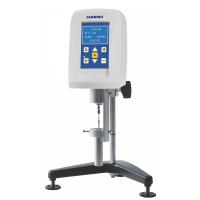
Six steps to use a Rotational Viscometer
(1) Accurately control the temperature of the measured liquid. The main factor affecting the viscosity is temperature. For example, the dynamic viscosity of water at 20 ℃ is 1.005 cp, and the dynamic viscosity of water at 21 ℃ is 0.981 cp. The temperature changes by 1 ℃, and the error reaches 2.4%, so special attention should be paid to the measured liquid The temperature is constant around the specified temperature point. When in use, immerse the rotor in the measured liquid for a long enough time and keep constant temperature at the same time, so that it can be consistent with the temperature of the measured liquid, reducing the influence of temperature fluctuations on the measurement accuracy.
(2) Rotor selection. First roughly estimate the viscosity range of the sample to be tested. For high-viscosity samples, choose small-volume (No. 3, No. 4) rotors and slow speeds. For low-viscosity samples, choose large-volume (No. 1, No. 2) rotors and fast speeds. The percentage scale (torque) of each output is a normal value between 20% and 90%, and the viscosity value measured in this range is the correct value. At the same time, the measurement should place the rotor in the center of the container as much as possible to reduce the measurement error caused by the rotation bias.
(3) The performance index of the viscometer needs to meet the requirements of the National Metrology Verification Regulations. The viscometer in use should be checked periodically. If necessary (the viscometer is frequently used or in a critical state of qualification), an intermediate self-examination should be carried out to ensure that its measurement performance is qualified. , the coefficient error is within the allowable range, otherwise accurate data cannot be obtained.
(4) Prevent air bubbles from adhering to the bottom of the rotor when the rotor is immersed in liquid. There are often air bubbles when the rotor is immersed in the liquid. Most of them will float up and disappear after a period of time after the rotor rotates. Sometimes the air bubbles attached to the lower part of the rotor cannot be eliminated. The existence of air bubbles will bring large deviations to the measurement data. When using The rotor should be dipped into the sample holder at an incline slowly, which can effectively reduce the generation of air bubbles. Ensure the uniformity of the liquid.
(5) Selection of range, coefficient, rotor and speed.
A. First roughly estimate the viscosity range of the liquid to be measured, and then select the appropriate rotor and speed according to the range table; for example, when measuring a liquid of about 2500mPa·s, the following combination can be selected: No. 2 rotor is 6 rpm; No. 3 rotor 30 rpm.
B. When the approximate viscosity of the liquid to be tested cannot be estimated, it should be assumed to be a higher viscosity, and try the rotor from small to large and the speed from slow to fast. The principle is to use a small rotor (high rotor number) and slow speed for high-viscosity liquids; use a large rotor (low rotor number) and fast speed for low-viscosity liquids.
C. When measuring, the reading indicated by the pointer on the dial needs to be multiplied by a specific coefficient on the coefficient table to obtain the measured viscosity (mPa·s).
u=k·a
In the formula, Zi is the viscosity; K is the coefficient; A is the reading (deflection) pointed by the pointer.
(6) If the power frequency is not accurate, it should be corrected according to the correction formula. For some instruments in Japan, Europe and the United States, the nominal frequency is 60Hz, and frequency correction is required, otherwise a 20% error will occur. The correction formula is:
Actual Viscosity = (Indicated Viscosity Yi Nominal Viscosity) / Actual Frequency
This article is excerpted from Yang Bin's "On the Use of Rotational Viscometer".