

China WZJ-II Bending machine coating T-Bending tester
SE WZJ-II

-
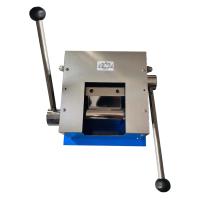 JINGKELIAN QZW T-bending test machine Color plate or strip film flexibility test$ 541.00SE
-
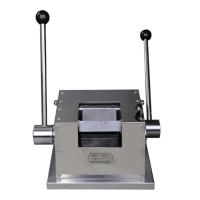 MODERNER WZJ-II Bending machine, testing equipment for measuring the bending resistance performance of color steel plates and Aluminum Panels
-
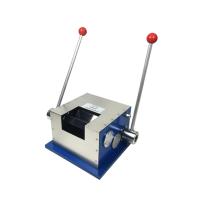 JFL QZW T-type bending test machine 45 ° primary bending angle$ 645.00SE
-
 TRUIT TR 5220 T Bending Testing Machine$ 917.00SE
-
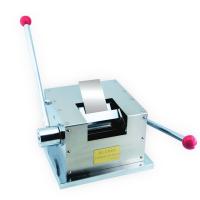 PUSHEN WZJ-II T Bending tester$ 786.00SE

SHIBO WZJ-II Bending machineSPEC
SHIBO WZJ-II Bending machineDetails
SHIBO WZJ-II Bending machinePacking list
- SKU
- NB024720
- primary bending angle
- <45°
- Flattening mechanism travel
- ≥10mm
- Film thickness
- 0.5~ 1.0mm (steel plate, aluminum plate), soft substrate up to 2mm
Application
Coating film flexibility is one of the important indicators to measure coatings, and it has great reference value for the screening of new product coating formulations.
The WZJ-II bending machine designed and manufactured according to the national standard GB/T12754 is a new model for testing the flexibility of coatings. It is suitable for testing the coating T-shaped bending Tester of colored steel plates and steel strips, as well as the coating of related products. T-bending Tester.
Principle
Through the rotation of the left handle, the square bending block presses the bending piece and forms a shape with an angle of <45°; turning the right handle drives the crank lifting mechanism to make the triangular bending rise and fall quickly, so that the test piece is clamped or pressed Flat, forming a T-shaped bend.
The main structure
1. Bottom plate and left and right side plates.
2. Gear pair and crank lifting mechanism.
3. The triangular bend is fast.
4. Rotate the square to dismantle the stacked blocks.
5. Composition of guard plate and handle.
Operation steps
1. Specifications 400×100 (mm)
2. The sample piece should be placed in an environment of 23+2°C for at least 24 hours before cutting, and the test should also be carried out under the same conditions.
3. Turn the right handle to pick up the triangular bending and flattening block in the middle of the testing machine (≥10mm): turn the left handle at the same time to make the square rotating and unstacking block and the triangular bending and flattening block line up with the bottom surface state. (as the picture shows)
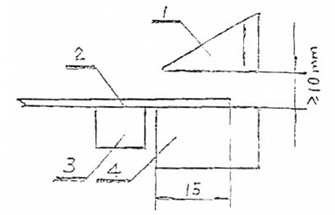
(1) Fast flattening of triangular bends
(2) Sample plate
(3) Square rotating and stacking blocks
(4) Bottom plane
4. Put the side of the sample plate down and extend it into the center of the triangular bending and flattening by 15mm, turn the right handle to lower the triangular bending and flattening block, and press the sample plate tightly: turn the left handle to make the square rotate and unstack Bend the test panel so that the test panel forms an angle < 45°.
5. Turn the left handle to make the square rotating and stacking block return to its original position: turn the right handle to make the triangular bending and flattening block rise, and take out the sample plate.
6. Insert the test panel forming an angle of <45° into the triangular bending flattening block: turn the right handle to lower the triangular bending flattening block. At this time, the angled end of the test board is compacted to form a head of An arc and two parallel faces for the thickness dimension. This completes the "OT" bend.
7. Repeat the above test operation steps, press the test plate "OT" to test the bending part and perform bending and flattening, so that there is an intermediate layer of the test plate thickness in the bending part. This completes the "IT" test.
8. Repeat the above-mentioned experimental steps in order to get "2T, 3T"....... bending (as shown in the figure)

Judgment of experimental results
Use scotch tape (≥0.25N/mm) to stick to the curved surface of the test, flatten the tape with your fingers, and then tear it off immediately perpendicular to the coating surface to check whether the coating at the bend is peeled off or falls off, so that Determine the flexibility of its coating.
Precautions for use
1. When the specimen is bent at IT, there should be no obvious gap at the overlap of the bending surface, otherwise the test should be repeated.
2. Coating damage within 10mm from the edge will not be considered.
3. For the convenience of transportation, when the testing machine leaves the company, the two handles are not installed on the main machine. After unpacking the box, the user installs the two handles on the corresponding positions of the host.
- 1HG/T 5173-2017《Waterborne primer for application on rusty substrates》
- 2SH/T 3022-2019《Design standard for anticorrosion coating of equipment and piping in petrochemical industry》
- 3ASTM 《Standard Specification for Aluminum Particle-Filled Basecoat/Organic or Inorganic Topcoat, Corrosion Protective Coatings for Fasteners》
- 4JT/T 821.1-2011《Anti-corrosive coatings for concrete bridge surface.Part 1: Solvent based coatings》
- 5DL/T 2308-2021《Technical specification for conductive anticorrosion coating for grounding in power engineering》
- 6JG/T 224-2007《Anticorrosive coatings for building steel structure》
- 7SY/T 4106-2016《Specification of solvent - free polyurethane coatings for steel pipelines and tanks》
- 8HG/T 5060-2016《Anticorrosive coatings for liquified natural gas (LNG) tanks》
- 9HG/T 4338-2012《High-chlorinated polyethylene anti-corrosion coatings》
- 10 0025-2018《PBC Biological Heavy Anti-corrosion Coating》