
China QTY-32 paint film cylindrical mandrel bending tester, paint film bending test machine
SE QTY-32

-
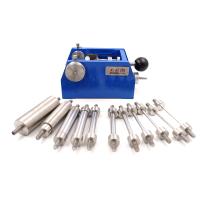 JINGKELIAN QTY-32 cylindrical mandrel bending Tester to determine the ability of the paint film to deform with the substrate without damage$ 283.00SE
-
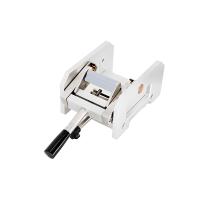 TRUIT TR 5212 cylindrical mandrel bending instrument$ 523.00SE
-
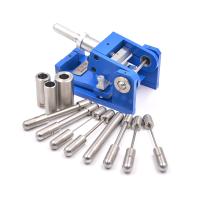 Pushen QTY-32 Bending Tester$ 512.00SE
-
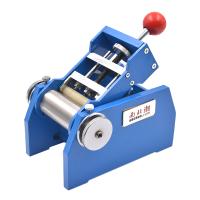 QTY-32 Lacquer film cylindrical Bending Tester YONGLIDA maximum shaft rod diameter 32mm$ 342.00SE
SHIBO QTY-32 Paint film cylindrical Bending testerSPEC
SHIBO QTY-32 Paint film cylindrical Bending testerDetails
SHIBO QTY-32 Paint film cylindrical Bending testerPacking list
- SKU
- NB024737
- Shaft rod size
- 2/3/4/5/6/7/8/10/12/16/20/25/32mm
- Plate thickness
- <1.0mm
- Operation mode
- manual
- Standards
- GB/T 6742
- Dimensions
- 170*110*230mm
- Shipment Weight
- 7Kg

QTY-32 Paint Film Cylindrical Bending Tester is mainly used to measure the film flexibility of paints and varnishes, which is one of the main indicators to measure the performance of paints. It should be of great reference value.
1. Scope of use
QTY-32 Paint Film Cylindrical Bending Tester is mainly used to measure the film flexibility of paints and varnishes, which is one of the main indicators to measure the performance of paints. It should be of great reference value.
QTY-32 Paint Film Cylindrical Bending Tester is a special instrument for evaluating the cracking resistance or peeling performance of the coating of paint, varnish and related products when it is bent around the cylindrical axis under standard conditions, and it is in line with GB6742. standard.
2. Structural principles and parameters
1. Principle
The ductility of the coating film to the substrate is also different with different bending radii. The flexibility of the coating film is judged according to the different bending radii or peeling conditions.
2. Main parameters
QTY-----32 type paint film bending Tester shaft diameters are 2, 3, 4, 5, 6, 8, 10, 12, 16, 18, 20, 25, and 32, mm
The adjustment quantity of the rotating shaft handle is greater than 17mm, and the gap is 0.1mm when it is tightly attached to the test rod
This instrument is suitable for samples with a thickness below 1.0mm.
3. Use and operation
1. Sampling, coating, drying and thickness measurement according to product standard requirements.
2. Place the QTY-32 paint film bending Tester on the edge of the test bench so that the adjustment handle can be freely operated and inserted into the model.
3. Select a suitable shaft rod according to the product requirements. Insert the base of the Tester and the shaft into the ground, and fasten with the manual lock nut.
4. Turn the adjusting hand wheel to lower the supporting plate, insert the coating film of the sample plate downwards between the shaft rod and the adjusting handle, and press the sample plate tightly with fastening screws and pressure strips on the supporting plate.
5. Turn the adjusting hand wheel to lift the supporting plate so that the model is close to the shaft rod.
6. Lower the adjustment handle to the lowest position, adjust the knob of the compression shaft on the handle, so that the compression shaft is close to the model.
7. Lift the adjustment handle, and lift it up 180°smoothly rather than suddenly within 1----2S. At this time, the sample plate on the shaft is also bent
180°.
8. Turn the adjustment handwheel, lower the supporting plate, and take out the curved model away from the shaft rod.
9. Sample inspection:
After bending, do not take the sample out of the instrument, check the sample immediately, and use normal vision or a 10 times magnifying glass to check whether the coating is cracked or peeled off from the bottom plate (excluding the coating less than 10mm away from the edge of the plate) according to the product standard requirements, but Indicate the use of a magnifying glass. In order to facilitate the misunderstanding of normal vision results.
10. The operating procedure for identifying the diameter of the shaft that first causes damage
According to the above operation, use this method (from large to small) to test smaller diameter shafts until the coating film cracks or peels off the base plate, and then repeat the operation with the same shaft diameter on a new sample plate. After proving this result, record the first Shaft diameter that cracks or peels off the coating film. If the smallest diameter mandrel does not fail the film, record that the film was bent on the smallest diameter mandrel without failure.
11. Test environment conditions
In order for the results to be judged correctly, the test should be carried out at a temperature of 23±2°C and a relative temperature of 50±5%.
4. Precautions when using
1. In order to prevent the coating from being damaged during the bending operation, a piece of thin paper can be attached to the coating surface of the model, and then inserted between the supporting plate and the adjusting handle for testing.
2. If you use a 10 times magnifying glass to observe the test results, it should be noted.
3. No cracking or peeling occurs with the smallest diameter mandrel, in which case the diameter of this mandrel shall also be indicated.
4. If the sample is an aluminum plate, its long side should be parallel to the rolling direction.
5. When the QTY-32 paint film bending Tester is not used for a long time, all shafts should be coated with anhydrous Vaseline.
- 1Cylindrical mandrel Bending Tester for high resilience coating flexibility
- 2Bending tester for cylindrical mandrel coating
- 1JB/T 3078-2015《Varnishes used for electrical insulation.Silicone impregnating varnishes》
- 2HG/T 5173-2017《Waterborne primer for application on rusty substrates》
- 3SH/T 3022-2019《Design standard for anticorrosion coating of equipment and piping in petrochemical industry》
- 4ASTM 《Standard Specification for Aluminum Particle-Filled Basecoat/Organic or Inorganic Topcoat, Corrosion Protective Coatings for Fasteners》
- 5ISO FDIS 1519-2010《Paints and varnishes. Bend test (cylindrical mandrel)》
- 6NF 《Paints and varnishes - Bend test (cylindrical mandrel)》
- 7 2099-2013《Paints and varnishes.Bend test(cylindrical mandrel)》
- 8DIN EN ISO 1519-2003《Paints and varnishes - Bend test (cylindrical mandrel)》
- 9NF EN ISO 1519-2002《Paints and varnishes - Bend test (cylindrical mandrel).》
- 10JT/T 821.1-2011《Anti-corrosive coatings for concrete bridge surface.Part 1: Solvent based coatings》