Reader's Guide
This manual is compiled based on manufacturer's data. Due to equipment batch changes, the content may not fully match every physical unit. Please refer to the actual operation and on-device labels.
Copyright belongs to the manufacturer. For internal reference of purchasers only. If safety parameters in the manual differ from the physical unit, please suspend operation and consult our engineer for confirmation.
Disclaimer: This manual is for reference only. In case of any discrepancy, the physical unit shall prevail. Our company assumes no liability for any consequences arising from operations based on this manual.
QTY-32 type film Bending tester instruction manual
QTY-32 Paint Film Bending Tester
1. Scope of Application
The QTY-32 paint film bending tester is mainly used to determine the flexibility of colored and varnish coating films. It is one of the primary indicators for evaluating coating performance and is highly valuable for selecting and applying coating varieties.
The QTY-32 Paint Film Bending Tester is a specialized instrument for evaluating cracking or peeling off metal when bending around a cylinder under coating standard conditions for colored paints, varnishes, and related products, and complies with the GB5742 national standard.
2. Working Principle
Different bending radii also affect the ductility of the substrate. The flexibility of the coating film is judged based on the cracking or peeling conditions at different bending radii.
3. Main Parameters
The shaft diameters of the QTY-32 Paint Film Bending Tester are 2, 3, 4, 5, 6, 8, 10, 12, 16, 20, 25, and 32 mm respectively.
The adjustment of the swivel handle should be greater than 17mm, and the allowable gap when close to the test rod is 0.05mm.
The lifting amount of the support plate component should be greater than 17mm, and the allowable gap when adhering tightly to the test rod is 0.1mm.
This instrument is suitable for samples with a thickness of less than 1.0mm.
4. Usage and Operation
Sampling, coating, drying, and thickness measurement according to product standard requirements.
Place the QTY-32 paint film bending tester at the edge of the test workbench so that the adjustment handle is nearly perpendicular to the base plate, making it easy to insert the test plate.
Select a suitable shaft bar according to product requirements. Insert into the instrument's shaft sleeve.
Insert the sample film face down between the shaft rod and the lifting support plate, and tighten the fastening bolts on the support plate. (See the image below)
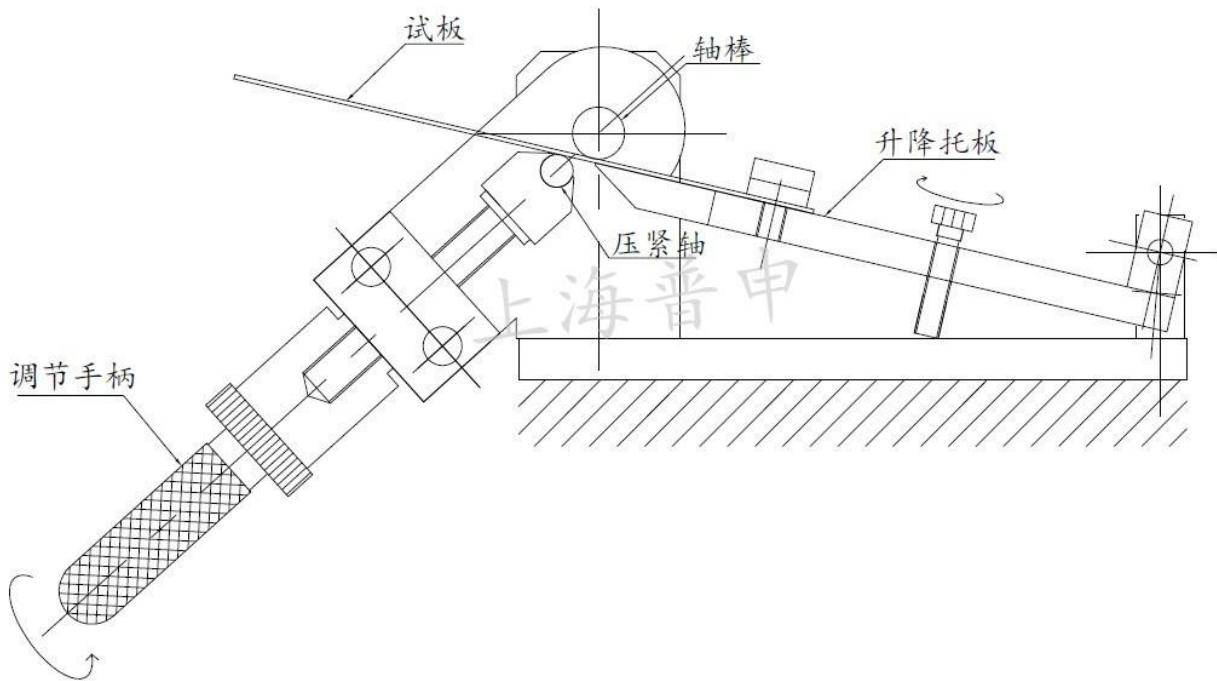
Rotate the nut on the lifting support plate so that the support plate and the test plate are tightly pressed against the test rod.
Place the handle in the lowest position and adjust the bolts on the handle so that the pressing shaft fits closely against the sample.
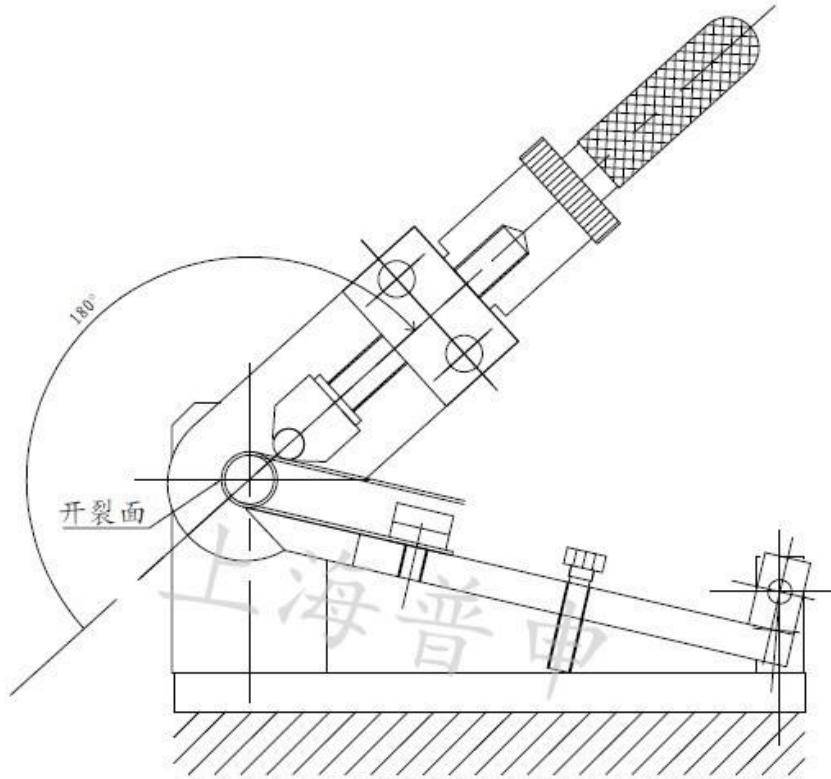
Lift the adjustment handle and smoothly lift it 180° within 1~2 seconds; at this point, the template on the shaft will also bend 180° accordingly. (See the image below)
5. Sample testing and testing environment
After bending, do not remove the sample from the instrument; immediately inspect the sample. Use normal vision or a 10x magnifying glass to check for cracking or peeling off the base plate (excluding coatings less than 10mm from the edge of the board), but the use of a magnifying glass must be specified. This is to avoid confusion with normal vision results.
Procedure for identifying the shaft diameter that first causes damage: Based on the appeal operation, the shaft with the smaller diameter is tested sequentially (from largest to smallest) until the coating cracks or peels off the base plate. Then, a new test plate is repeated with the same shaft diameter. After proving this result, the shaft diameter that causes coating cracking or peeling first is recorded. If the smallest shaft cannot also damage the coating, then record that the coating is not damaged when bent on the smallest shaft warp.
To ensure accurate results, the test should be conducted at a temperature of 23±2°C and a relative humidity of 50±5%.
6. Notes
To prevent coating damage during bending, a thin sheet of paper can be attached to the coated surface of the template, then inserted between the tray and the adjustment handle.
If the test results are observed with a 10x magnifying glass, this should be noted in the report.
Using the smallest shaft diameter will not cause the coating to crack or peel, and the report should also indicate this shaft diameter.
If the template is made of aluminum, its long edge should be parallel to the calendering direction.
If the QTY-32 paint film bending tester is not used for a long time, all shaft rods should be coated with anhydrous petroleum jelly.
-
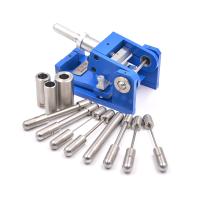
![Pushen QTY-32 Bending Tester]() Pushen QTY-32 Bending Tester$ 512.00
- 1PUSHEN CJQ-II Film Impact Device Instruction Manual
- 2PUSHEN NMC-II Wear friction tester instruction manual
- 3PUSHEN RJCS solvent rub tester, instruction manual
- 4PUSHEN RJCS solvent rub tester instruction manual
- 5PUSHEN PS 2812 Mixing Sand Mill Dispersion Multipurpose Machine Instruction Manual
- 6PUSHEN PS 2816/2817 Series Blue Devil Paint Rapid Dispersion Testing Machine Instruction Manual
- 7FANGRUI DC/HDC (W) series horizontal Thermostatic bath manual
- 8JFL QFH-A600 cross-cut tester instruction manual
- 9PUSHEN ZS series, manual Ink Proofer instruction manual
- 10PUSHEN JFB-I Portable reflectivity meter instruction manual