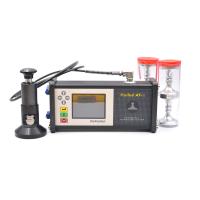
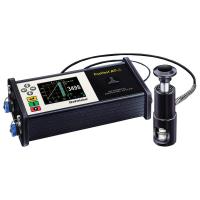
Pull-up adhesion test steps and selection ideas
The pull-off adhesion test is a common method used to determine the bond strength or adhesion of coatings, adhesives, or other materials to a substrate. It measures the force required to pull a coating or adhesive away from a substrate, providing an indication of the strength of the bond.
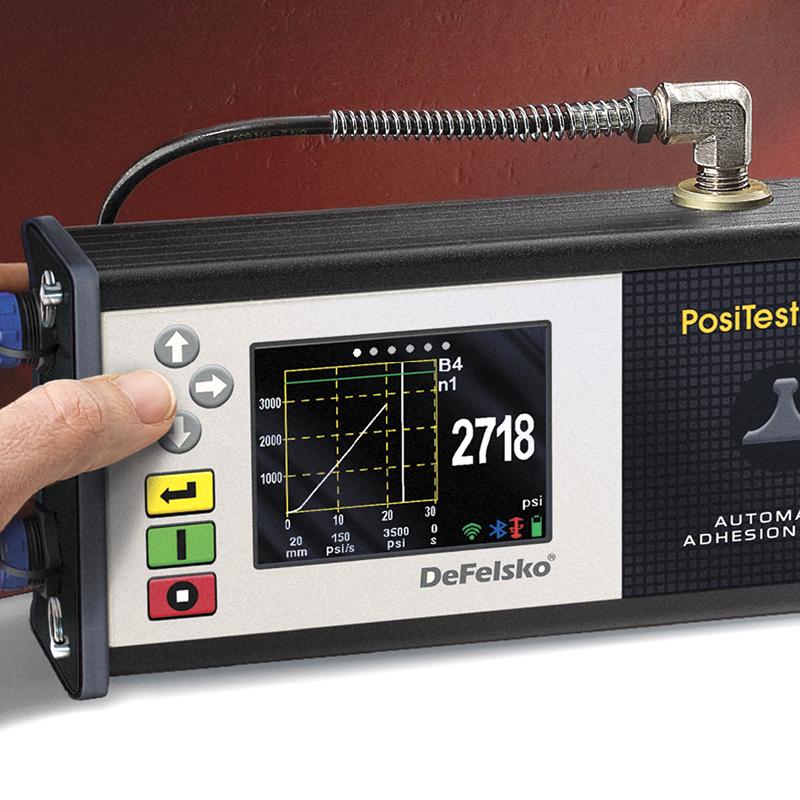
Here are the general steps involved in performing a pull-off adhesion test:
Sample Preparation: Prepare the test samples according to the specifications of the coating or adhesive being tested and the requirements of the test standard or procedure. This may involve applying the coating or adhesive to the substrate using appropriate techniques, such as spraying, brushing, or spreading, and allowing it to cure or dry as per the manufacturer's instructions.
Test Equipment Setup: Set up the pull-off adhesion test equipment according to the manufacturer's instructions or the relevant test standard. This typically involves attaching a test fixture or probe to the coated surface using an adhesive, and ensuring that the fixture is properly aligned and centered on the test area.
Test Execution: Initiate the pull-off test by applying a gradually increasing force to the test fixture or probe, pulling it perpendicular to the surface of the coated sample. The force is applied until the coating or adhesive fails and detaches from the substrate, and the maximum force or stress required to cause the failure is recorded.
Data Collection: Collect and record the data generated during the pull-off test, including the maximum force or stress applied before failure, the mode of failure (e.g., cohesive, adhesive, or substrate failure), and any other relevant observations or measurements.
Data Analysis: Analyze the collected data to determine the bond strength or adhesion of the coating or adhesive. This may involve calculating the stress or force per unit area (e.g., psi or N/mm^2) based on the test results, and comparing it to specified acceptance criteria or standards.
Interpretation of Results: Interpret the test results in the context of the specific application or research question. Consider factors such as the material properties, coating thickness, substrate condition, and environmental conditions that may affect the adhesion performance.
Report and Documentation: Document the testing procedure, results, and analysis in a clear and comprehensive manner. This may involve preparing a formal report, recording relevant experimental details, and noting any observations or insights for future reference.
It's important to follow the relevant test standard or procedure, and carefully execute the test to obtain accurate and reliable results. Consulting with an experienced testing professional or referring to relevant guidelines or standards can be beneficial for proper test setup, execution, and interpretation of results.
Choosing the right pull-off adhesion Tester involves considering several factors, including the type of material being tested, the required test parameters, the intended application, budget constraints, and other specific requirements. Here are some general steps to help guide you in choosing a pull-off adhesion Tester:
Define Your Testing Requirements: Clearly identify the specific requirements of your pull-off adhesion testing, such as the expected range of bond strengths, the type of materials being tested (e.g., coatings, adhesives), the size and shape of the test samples, and any relevant test standards or specifications.
Consider Test Parameters: Different pull-off adhesion Testers may offer different test parameters, such as maximum force capacity, pulling speed, accuracy, and resolution. Consider the test parameters that are most relevant to your specific testing needs, and choose a Tester that meets those requirements.
Evaluate Test Modes: Pull-off adhesion Testers may offer different test modes, such as manual, motorized, or automated. Consider the level of automation or motorization that is required for your testing needs, based on factors such as sample throughput, test repeatability, and operator skill level.
Budget Considerations: Pull-off adhesion Testers come in a wide range of prices, so consider your budget constraints and determine the maximum budget you can allocate for a Tester. Keep in mind that more advanced features and capabilities may come at a higher cost.
Consider Instrument Features: Consider additional features that may be important for your testing needs, such as data logging and analysis capabilities, ease of use, sample handling, and after-sales support, among others.
Evaluate Durability and Reliability: Consider the durability and reliability of the pull-off adhesion Tester, as these factors can affect the accuracy and repeatability of test results. Look for Testers from reputable manufacturers with a history of producing reliable and robust testing equipment.
Seek Recommendations and Reviews: Seek recommendations from experienced users, testing professionals, or manufacturers to gain insights into the best pull-off adhesion Testers available in the market. Read reviews and testimonials from other users to understand their experiences with the Testers you are considering.
Evaluate Technical Support: Consider the level of technical support offered by the manufacturer, such as availability of user manuals, training resources, and customer support services. Good technical support can be valuable in ensuring proper setup, calibration, and maintenance of the Tester.
Consider Long-term Needs: Consider your long-term needs and growth potential. Choose a pull-off adhesion Tester that can accommodate potential future testing requirements, and has options for software upgrades, accessories, or expansion as needed.
Compare Options: Once you have identified your requirements, budget, and priorities, compare different pull-off adhesion Testers based on their specifications, features, and cost, and evaluate their pros and cons.
Make an Informed Decision: Based on the above considerations, make an informed decision on the pull-off adhesion Tester that best meets your specific testing needs, budget, and requirements.
Choosing the right pull-off adhesion Tester requires careful consideration of your specific testing needs, budget, instrument features, reliability, and other relevant factors. Thorough research, comparison of options, and consultation with experts can help ensure that you select a pull-off adhesion Tester that will provide accurate and reliable results for your intended application or research.
-
![RUNJIE RJ-M Adhesion Tester 14mm]() RUNJIE RJ-M Adhesion Tester 14mm$ 1237.00
RUNJIE RJ-M Adhesion Tester 14mm$ 1237.00 -
![KOSON KS-T Manual pulling method coating adhesion Tester, top 50mm]()
-
![KOSON KS-T intelligent drawing adhesion instrument, top 10mm]()
-
![KOSON KS-T Intelligent Adhesion Tester Spindle 14mm]()
-
![KOSON KS-A Automatic Digital Display Adhesion Tester]()
-
![KOSON KS-T smart Adhesion Tester]() KOSON KS-T smart Adhesion Tester$ 1086.00
KOSON KS-T smart Adhesion Tester$ 1086.00 -
![RUNJIE RJ-M Adhesion Tester 50mm]() RUNJIE RJ-M Adhesion Tester 50mm$ 1360.00
RUNJIE RJ-M Adhesion Tester 50mm$ 1360.00 -
![RUNJIE RJ-M Adhesion Tester platings adhesion instrument 10mm]()
-
![CHINA Pull-off adhesion Detector NBC-M kit 10mm]()



- 1Film adhesion detection method and its applicability analysis
- 2Purpose, method, principle and operation points of coating adhesion test
- 3Working principle and application of UV coating Cupping testing device
- 4Principle and Application Analysis of Film Adhesion Tester
- 5Optical inspection device Anti-reflection film adhesion Measuring method
- 6Automatic scratch test to evaluate film strength, hardness, adhesion
- 7Comparison of film adhesion determination methods
- 8Determination of film adhesion
- 9Paint film adhesion and test method thereof
-
![RUNJIE RJ-M Adhesion Tester 14mm]() RUNJIE RJ-M Adhesion Tester 14mm$ 1237.00
RUNJIE RJ-M Adhesion Tester 14mm$ 1237.00 -
![RUNJIE RJ-M Adhesion Tester 50mm]() RUNJIE RJ-M Adhesion Tester 50mm$ 1360.00
RUNJIE RJ-M Adhesion Tester 50mm$ 1360.00 -
![RUNJIE RJ-M Adhesion Tester platings adhesion instrument 10mm]()
-
![RUNJIE RJ-M Adhesion Tester 20mm]() RUNJIE RJ-M Adhesion Tester 20mm$ 1237.00
RUNJIE RJ-M Adhesion Tester 20mm$ 1237.00 -
![Defelsko PosiTest AT-A 50mm Adhesion Tester kit Size 50mm Fully automatic]()
-
![Defelsko PosiTest AT-A 20mm Pull-off adhesion Tester 20mm kit size]()