Circle-drawing method for determination of adhesion
Coating adhesion refers to the degree of adhesion between the coating and the substrate, and is one of the important indicators for evaluating Coating performance. There are many methods for measuring adhesion, one of which is the Circle-drawing method. This article will introduce the principle, instrument, measurement method and result representation of the Circle-drawing method.
1. Scope and description
The circle-drawing method is a method used to measure coating adhesion. In this method, the template is fixed on a movable platform, and then as the platform moves, a stylus is used to cut through the coating to form overlapping circular rolls. The adhesion of the coating is expressed in grades according to the degree of coating integrity within the scratch range of the circular roll line.
2. Instruments and materials
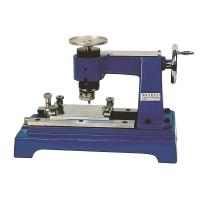
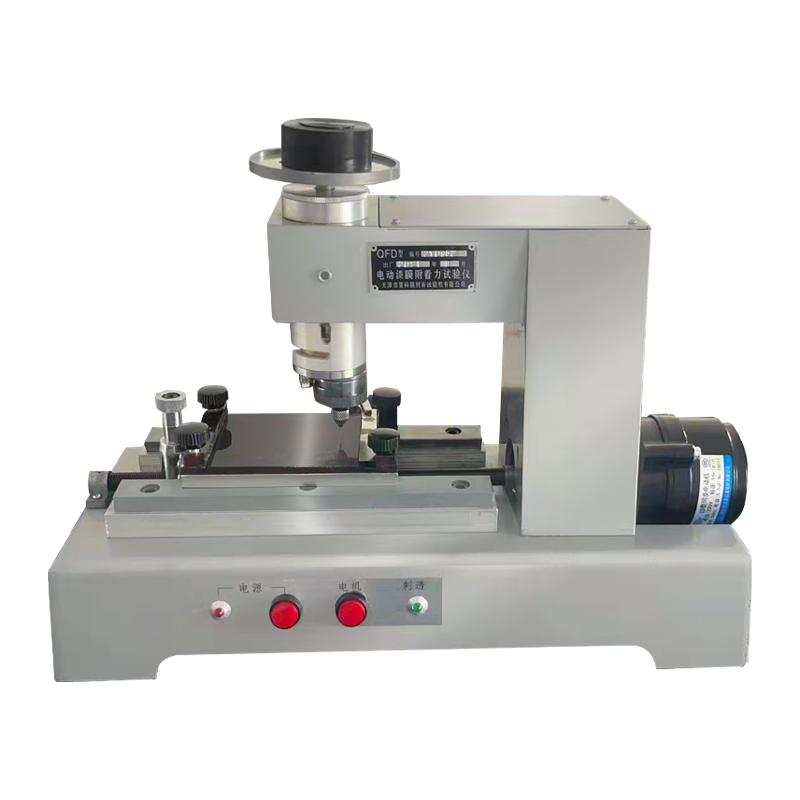
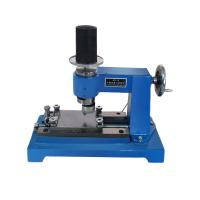
Adhesion Tester: The instrument includes a test bench, a rotating needle, a load plate, a chuck plate and other components. The screw pitch of the test bench is 1.5mm, and the rotating needle adopts a stylus of a specific specification, and the no-load pressure is 200g. Weight can be placed on the load plate, and the masses are 100g, 200g, 500g and 1000g respectively. The radius of rotation of the rotating needle can be adjusted, and the standard radius of rotation is 5.25mm.
Quadruple magnifying glass
Paint brush: The width is between 25~ 35mm.
3. Determination method
(1) Inspection equipment
Before testing, first check whether the stylus of the adhesion Tester is sharp. If it is not sharp, it needs to be replaced. Also check whether the scratch matches the standard radius of rotation. If it does not match, the radius of rotation needs to be adjusted.
(2) Adjust the instrument
Adjust the radius of rotation of the instrument to ensure that it is the same as the standard radius of rotation 5.25mm. This step requires loosening the bolt behind the chuck, adjusting the radius of rotation, and then tightening the bolt until scratch matches the standard round roll line.
(3) Carry out the measurement
Place the sample coating on the test bench facing up and fasten the adjusting bolts for fixing the sample.
Move the lift rod back so that the tip of the rotary needle touches the coating.
Shake the handle evenly in the clockwise direction to control the Rotation speed at 80~ 100r/min.
Circle-drawing on the coating to form a circular scroll scratch. The standard length of a circular scroll scratch is (7.5 soil 0.5) cm.
(4) Inspection and Rating
After finishing the scratch, move the lift rod forward, lift the chuck plate, loosen the relevant bolts that hold the sample, and remove the sample. Then, use a paint brush to remove the paint chips from the scratch, use a quadruple magnifying glass to inspect the scratch, and grade.
According to the degree of completeness of the coating on the scratch, the scratch of different parts is marked with seven parts: 1, 2, 3, 4, 5, 6, and 7, and divided into seven grades. The recommended adhesion is one level, and the worst is seven levels. The result is subject to the same level of at least two samples.
4. Presentation of results
The result of adhesion is expressed by the lowest level of coating integrity. This means that if the coating integrity of a certain part reaches a certain standard, the overall adhesion level will be based on the grade of this part.
5. Reference standard
When performing adhesion measurement, you can refer to the national standard GB/T 1720 "Determination of paint film adhesion".
The Circle-drawing method is a commonly used method for measuring coating adhesion. The adhesion between the coating and the substrate is evaluated by the circular roller scratch generated by the Circle-drawing. This method is simple and easy to implement, and can quickly and accurately evaluate the adhesion performance of coatings. It is of great significance for quality control and product evaluation in the Coating industry.
- 1Film adhesion detection method and its applicability analysis
- 2Purpose, method, principle and operation points of coating adhesion test
- 3Working principle and application of UV coating Cupping testing device
- 4Principle and Application Analysis of Film Adhesion Tester
- 5Optical inspection device Anti-reflection film adhesion Measuring method
- 6Automatic scratch test to evaluate film strength, hardness, adhesion
- 7Comparison of film adhesion determination methods
- 8Determination of film adhesion
- 9Paint film adhesion and test method thereof