Introduction of wet film thickness measuring instrument
Wet film thickness measurement is generally used by experimenters to determine the specified amount of paint to be applied to obtain the expected dry film thickness.
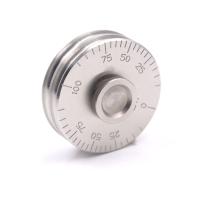
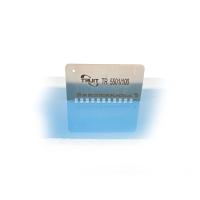
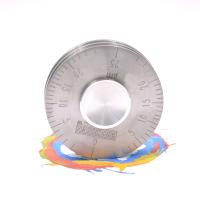
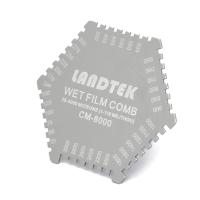
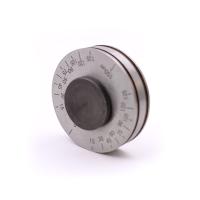
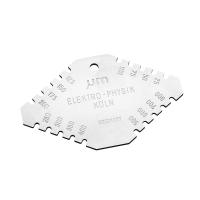
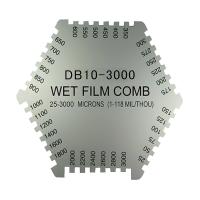
There are generally two types of wet Film Thickness Gauges: wet film thickness wheel gauge and wet film thickness comb gauge. The advantage of using a wet Film Thickness Gauge is that inappropriate film thickness can be checked and corrected during the coating process. If the Tester knows the wet film thickness, the dry film thickness can be estimated when this data is multiplied by the volume percentage of the paint solids.
Dry film thickness (μm) = wet film thickness (μm) * paint solids (volume%)
Actual dosage of paint (kg) = (1 + α) * Theoretical coating amount of paint (kg/m2) * Coating area (m2) (α is the coating consumption coefficient)
In actual construction, due to the uneven surface of the coated object, the consumption during the coating process, the influence of environmental conditions such as stroke speed, and the influence of different types of construction tools, the coating must have different degrees of loss. The α value is not a constant, but is determined by various factors. Generally, the flat surface α of high pressure airless spraying is 0.6-0.8; the spraying complex surface is 0.8-1.0; the hand-painted flat surface α is 0.3-0.4; the hand-painted complex surface α value is 0.4-0.6.
Coating operators can use the wet film thickness meter to detect, construct, and adjust the wet film thickness at any time. During construction, the detection frequency of the warm film thickness can be arbitrary. When spraying a large and flat surface, the detection frequency can be smaller when the operation is skilled. In the case of complex structure of the coated surface and unskilled operation, the detection frequency can be larger. Generally, it is required to evenly distribute measurement points per 10 m2 of coated surface. Generally, 5 measurement points are distributed in 1 m2, each measured three times, and the average value is measured to improve the reliability of wet film thickness. In architectural coatings, destructive tests cannot be required or allowed on the surface of reinforced concrete, so the determination of wet film thickness can be used instead of dry film thickness measurement.
In most cases, the determination of the wet film thickness is only an auxiliary means to ensure the dry film thickness. For inorganic zinc-rich coatings and some fast-volatile coatings, the ratio of dry and wet films varies greatly. Only the wet film thickness is used to estimate the dry film thickness., may bring wrong results, evaluate the total thickness, or the dry film thickness shall prevail.




- 1How to measure and calculate the wet film thickness correctly? dry goods
- 2What is a wet Film Thickness Gauge?
- 3How to control the thickness of construction coatings? Conventional thickness of different coatings
- 4How to use the wet Film Thickness Gauge?
- 5How does the wet Film Thickness Gauge predict the dry film thickness of the coating?
- 6Wet Film Thickness Wheel Uses, Principles and Operating Procedures
- 7Why measurement Film thickness? How measurement?
- 8Coated steel coating mass control inspection instructions
- 9Painting mass evaluation - Determination of coating Film thickness
-
![MODERNER YQH-100 Wet Film Thickness Wheel Gauge 0~100μm/5μm]()
-
![TRUIT TR 5501/100 Wet Film Comb Gauge 10~100μm]()
-
![Germany Erichsen 234 R/I wet-film thickness measuring wheel WFT measurement Thickness Wheel]()
-
![LANDTEK CM8000 hexagonal wet-film gauge wet-film card, for WFT on the surface of a new paint layer, stainless steel material]()
-
![JINGKELIAN QUL WFT gauge 0~500μm]() JINGKELIAN QUL WFT gauge 0~500μm$ 123.00
JINGKELIAN QUL WFT gauge 0~500μm$ 123.00 -
![Defelsko PosiTest PC Non-Contact Uncured Powder Thickness Gauge]()