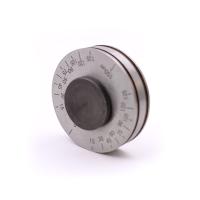
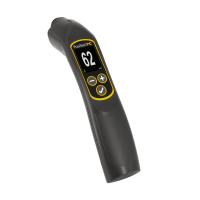
How to use the wet Film Thickness Gauge?
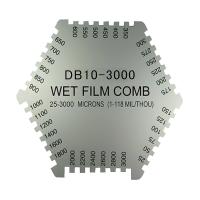
The Wet Film Thickness Gauge is designed to quickly and easily measure the thickness of a coating immediately after it has been applied to a substrate. These gauges are also commonly referred to as: comb gauges, MIL gauges, step gauges, and notch gauges. The sides of the gauge have a series of notches, like the teeth on a comb. Can measure wet film thickness of most organic coatings including paints, resins, varnishes, varnishes, gel coats and more. The thickness of powder coatings can also be measured before curing.
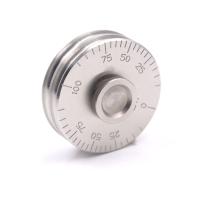
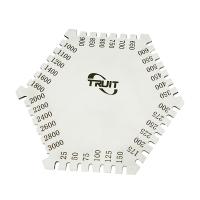
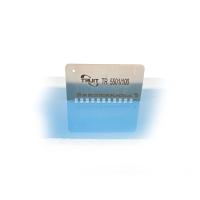
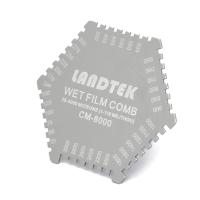
Wet Film Thickness Gauge display

operating principle

Teeth or notches are machined into the sides of the gauge. The teeth or notches on either side of the gauge are referenced to each other. For a given side, the two outer teeth or notches are the same size and are effectively zero reference data representing the base material. All other teeth or notches on the same side are shorter in length than the outer teeth or notches and are at a different distance from the outer edge zero reference tooth. These different distances represent the surface on which the wet coating thickness is to be measured. Teeth or notches are scaled in MILS (0.001").
specific operation
Hold the wet Film Thickness Gauge (wet film gauge) at a 90-degree angle to the coated substrate and penetrate the coated surface with the serrated or toothed side of the gauge until firm contact is made with the substrate. Wait a few seconds for the teeth or notches of the gage to "wet" with the coating, then withdraw the gage vertically so that it is at a 90-degree angle to the substrate. The gauge can now be read to determine wet film thickness. Visually inspect the ends of the teeth or gaps, some will be coated or "wetted" and some will not. The wet film thickness (WFT) of the coating is between the values of the smallest uncoated (dry) tooth or notch and the largest coated (wet) tooth or notch. Always clean the gauge with an appropriate solvent after use.
When using a gage to measure wet film thickness on rough substrates, it is likely that the thickness measurement will be taken from the surface "peak" and the wet film thickness measurement will represent the minimum total wet film thickness.
On curved surfaces such as pipes, cylinders, etc., the gauge should be used along the length or longitudinal axis of the curved surface.
If you are measuring fast-drying paint, perform the measurement quickly to avoid possible errors caused by curing.
Measuring Powder Coatings
The thickness of dry powder coatings can also be measured using these types of gauges. The mode of operation is similar to measuring "wet" coatings. The teeth or notches of the gauge should have a 90 degree "sag" over the coating and the thickness of the powder should be between the value of the smallest tooth or notch and the largest tooth or notch with which the powder will "stick" . No powder "sticks". The surface of the substrate can also be checked for "drag" marks left by teeth or notches to confirm the value read from the notches or teeth. A "drag" mark indicates that the coating should "stick" to the tooth or notch.

- 1How to measure and calculate the wet film thickness correctly? dry goods
- 2What is a wet Film Thickness Gauge?
- 3How to use the "Wet Film Thickness" meter
- 4How to control the thickness of construction coatings? Conventional thickness of different coatings
- 5How does the wet Film Thickness Gauge predict the dry film thickness of the coating?
- 6How to calculate the measured wet film thickness? The importance of WFT in coating construction
- 7Wet Film Thickness Wheel Uses, Principles and Operating Procedures
- 8Comparison of Selection of Three Types of TQC Wet Film Gauges
- 9Thickness Wheel method for determining thickness of wet film
-
![MODERNER YQH-100 Wet Film Thickness Wheel Gauge 0~100μm/5μm]()
-
![TRUIT TR 5506/3000 Wet Film Wheel Comb 25~ 3000μm]()
-
![TRUIT TR 5501/100 Wet Film Comb Gauge 10~100μm]()
-
![LANDTEK CM8000 hexagonal wet-film gauge wet-film card, for WFT on the surface of a new paint layer, stainless steel material]()
-
![JINGKELIAN QUL WFT gauge 0~500μm]() JINGKELIAN QUL WFT gauge 0~500μm$ 123.00
JINGKELIAN QUL WFT gauge 0~500μm$ 123.00 -
![Defelsko PosiTest PC Non-Contact Uncured Powder Thickness Gauge]()