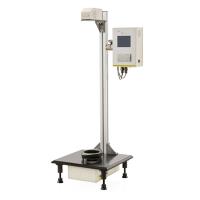
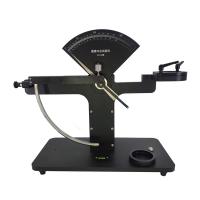
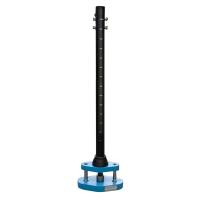
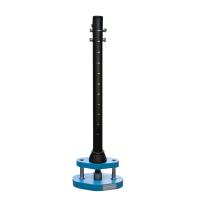
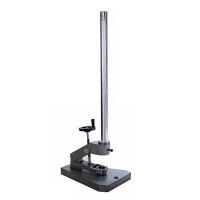
Determination of impact resistance of paint film - impact Tester
Impact resistance or impact resistance. The impact resistance of the coating film refers to the ability of the paint film to resist external impact. The paint film deforms rapidly under the action of high-speed gravity without cracking or falling off from the metal substrate. Elongation, static hardness and adhesion to the substrate of the paint film. This indicator is of great significance for evaluating the quality of coatings for vehicles and machinery. It should be noted that the impact force is actually a rapid deformation caused by the impact load and should be separated from the static load of the paint film. The deformation under static load conditions is affected by factors such as plasticity and time, but there is no such problem under impact load conditions.
The measurement of impact resistance is to drop a weight of a certain mass on the coating film sample plate, so that the coating film can undergo elongation and deformation without causing Impact resistance, usually expressed in N.cm (kgf. cm), is carried out with an impact Tester. The impact test can be divided into positive impact and recoil, that is, the coating film faces upwards as positive impact, and the coating film faces downward as recoil. For most coatings, recoil is more stringent than positive impact. The higher the height of the coating film through impact, the greater the impact resistance of the coating product. The thickness of the coating film as well as the thickness and surface preparation of the substrate will affect the impact strength results. Hence the need for standardization. CHINA's national standard "GB/T 1732-79 (88) Test method for impact resistance of paint film ) stipulates that the weight of the hammer is 1000g±1g, the depth of the punch entering the groove is 2mmn+0.1mm, and the sliding scale is equal to 50cm ± 0.1cm, The division is 1cm.
It is not difficult to see that the impact resistance performance is the joint embodiment of the adhesion of the coating film, the strength and ductility of the coating film, but it is different from the static
Deformation under load is rapid deformation caused by impact loads. It is also closely related to the mechanical loss (internal friction) of the coating film, which means that the material consumes the mechanical energy impact energy through the internal friction of the polymer chain segment movement into heat energy. Therefore, the greater , the stronger the ability to absorb impact energy, and the mechanical loss factor tan8 can measure the size of internal friction. For example, the design of the impact-resistant layer and damping coating in the middle of the car needs to be considered in the temperature range of use, so that the material has a larger tanδ in a wider frequency range . This can be achieved by designing the composition of the polymer chain by copolymerization.
The impact energy can be expressed by the area under the stress-strain curve when the material is stretched rapidly, which is the energy consumed when the material breaks at a high speed. Therefore, no matter what kind of method to improve the impact resistance, it is inseparable from the two aspects of improving the strength or increasing the elongation at break . Therefore, the coating film with high relative molecular weight, rigid and flexible molecular chains, and moderate crosslinking is strong and tough, and will have better impact resistance.
- 1Application of Pendulum Impact Instrument in Encasement Aluminum Plastic Paper Composite
- 2How to Evaluate Mechanical Properties of Cigarette Pack Aluminized Paper with Pendulum Impact Meter
- 3Application of Pendulum Impact Instrument in Nylon Membrane
- 4Sheet for Pendulum Impact Meter Application
- 5What are the specific applications of pendulum Impact Meter in Plastic film?
- 6General Impact Test for Paints and Coatings - ASTM D2794
- 7What is impact testing?
- 8What properties of liquid unsaturated polyester resin for buttons are necessary? What are the indicators?
- 9What properties of phenolic resin anti-rust coatings must be inspected? What are the indicators?