Paint Adhesion Test - Paint Film Scratch
Objective: To determine the adhesion of the paint, either to the substrate or to other layers in the paint system.
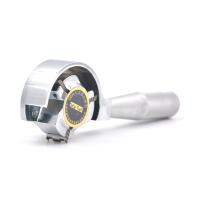
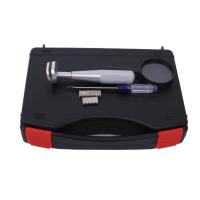
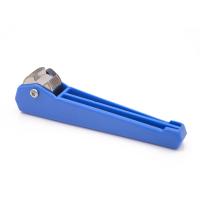
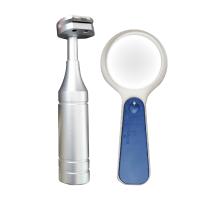
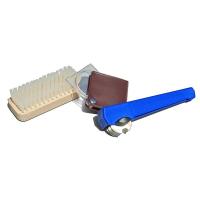
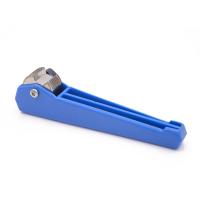
Equipment Needed: Paint scratcher, tape, cleaning solution, fresh water, clean rag
Procedure: Wear safety glasses and gloves.
Clean the test area using the Test 3 procedure - Clean Surface. Use Test 2 to check surface for presence of chalk, if positive clean until negative result.
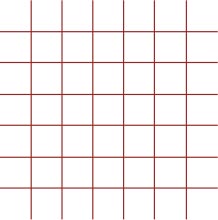
Using the lacquer scribe, cut 6 vertical lines about 3mm apart, then repeat the same 6 cuts horizontally on top of the vertical cuts already made (see picture below).
Place adhesion test tape over the grid area and wipe. Hold tape on surface for 90 seconds, then pull at a 45° angle at a consistent medium speed.
Notes: Before placing the tape on the grid, fold one end of the tape over to create a pull tab. Do not touch the sticky side of the tape until you have placed it on the grid. Repeat the process at several different sites.
Interpretation: Poor adhesion of the paint system or layers therein can be seen when there is substantial paint removal along the edge of the cut or when the square is dislodged.
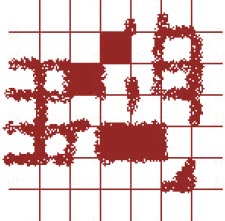
Try to identify the point of failure, ie if the substrate is exposed, the failure is at the base of the paint system (substrate adhesion failure), it is recommended to clean it all back to the bare substrate before painting.
If there is a failure within the paint layer (failure of intercoat adhesion), then where, i.e. at what color is exposed and what color is the backside of the removed paint?
A measure of the extent of failure can be calculated using the following equation:

*each square = 4% of total surface area so 1/2 sheet square = 0.5
For example, in the example above, you have 4 squares failing, but you have 4 additional squares with edge damage at 0.25 (1%) each, and one square with half missing, so say 0.5 (2%)
...so 4 x 4 = 16% area + 4 x 1 = 4% area + 1 x 2 = 2% area = 22% area failure
...or use the equation 4 squares + 4 x 1/4 squares + 1/2 squares =
5 1/2 x 100 / 25 = 22 so 22% of the area will fail to adhere
- 1Film adhesion detection method and its applicability analysis
- 2Purpose, method, principle and operation points of coating adhesion test
- 3Working principle and application of UV coating Cupping testing device
- 4Principle and Application Analysis of Film Adhesion Tester
- 5Optical inspection device Anti-reflection film adhesion Measuring method
- 6Automatic scratch test to evaluate film strength, hardness, adhesion
- 7Comparison of film adhesion determination methods
- 8Determination of film adhesion
- 9Paint film adhesion and test method thereof