
TEELEN XP-200B Trinocular Simple Polarizing Microscope
SETrinocular Simple Polarizing Microscope with polarizing and simple polarizing device, magnification 40-1600 times
Price: Please contact customer service
Model:
 XP-200B

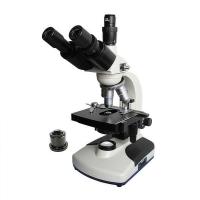
Teelen XP-200B Polarizing MicroscopeSPEC
Teelen XP-200B Polarizing MicroscopeDetails
Teelen XP-200B Polarizing MicroscopePacking list

- SKU
- NB025513
- observation head
- Three head (53mm-75mm)
- eyepiece
- WF10X/18 (pair)
- objective lens
- 4X dry mirror, numerical aperture 0.10NA working distance 17.5mm; 10 × dry mirror numerical aperture 0.25NA working distance 6.6mm; 40 × spring dry mirror, numerical aperture 0.65NA working distance 0.64mm; 100 × spring oil mirror, numerical aperture 1.25NA working distance 0.19mm
- Total Magnification
- 40X~1000X
- converter
- Inward tilting four-hole objective lens converter
- Mechanical barrel length
- 160 mm
- circular stage
- Diameter φ 120mm, 360 ° rotating load circle table, scale value 1 °, vernier value 6 ′
- Focusing system
- Coaxial coarse fine-tuning with focusing handwheel and parfocal lock, adjustment range: 25 mm Fine-tuning grid value: 0.002mm
- Abbe condenser
- N.A.1.25 Abbe Condenser Lens; Should 2-Should 30mm Variable Light Bar with Should 32 Color Filter
- Polarizing device
- Polarizer with swirling/spinning type and built-in polarizer for observation head
- lighting system
- Built-in dimming 6V20W halogen lamp
- Power
- 110-220V/50-60Hz
XP-200B
Polarizing Microscope
Trinocular Simple Polarizing Microscope with polarizing and simple polarizing device, magnification 40-1600 times

use
XP-200B Trinocular Polarizing Microscope is the required instrument for the research and identification of birefringent substances by using the polarization characteristics of light. Polarizing microscopy has a wide range of applications, such as observing the structural details of crystal inclusions in teeth, bones, hair, and living cells, nerve fibers, animal muscles, plant fibers, etc., and analyzing the denaturation process. The polarizing microscope can also observe the fine structure of the crystallization of various salts in inorganic chemistry that cannot be seen in natural light. Polarizing microscopes are mainly used in teaching and laboratories.

FAQ
QIs there a SY/T0442 Polarizing Microscope?
A
This TEELEN Polarizing Microscope is fine!
Standard
- 1GB/T 44268.2-2024《Microscopes—Definition and measurement of illumination properties—Part 2:Illumination properties related to the colour in bright field microscopy》
- 2GB/T 44268.1-2024《Microscopes—Definition and measurement of illumination properties—Part 1: Image brightness and uniformity in bright field microscopy》
- 3GB/T 44276.2-2024《Microscopes—Cover glasses—Part 2:Quality of materials, standards of finish and mode of packaging》
- 4GB/T 44276.1-2024《Microscopes—Cover glasses—Part 1:Dimensional tolerances, thickness and optical properties》
- 5GB/T 44293-2024《Image measurement method for numerical aperture of microscopic objective》
- 6GB/T 43846.1-2024《Microscopes—Designation of microscope objectives—Part 1: Flatness of field/Plan》
- 7GB/T 43846.2-2024《Microscopes—Designation of microscope objectives—Part 2: Chromatic correction》
- 8GB/T 43846.3-2024《Microscopes—Designation of microscope objectives—Part 3: Spectral transmittance》
- 9GB/T 13777-2024《Test method for maturity of cotton fibers—Microscopic method》
- 10JB/T 8230.1-1999《Light microscope Vocabulary》