
PNSHAR PN-NZ135 Folding Tester
 PN-NZ135


PNshar PN-NZ135 Folding TesterSPEC
PNshar PN-NZ135 Folding TesterDetails
PNshar PN-NZ135 Folding TesterPacking list
- SKU
- NB028480
- Power supply Voltage
- AC220V±10% 2A 50Hz
- number of double folds
- 0~99999 times
- folding logarithm
- 0~4.99
- folding angle
- 135±2°
- folding speed
- 175±10CPM
- Spring tension
- 4.91~14.72N
- crease radius
- 0.38±0.02mm
- Folding mouth seam distance
- 0.25mm/0.5mm/0.75mm/1.00mm
- Human Machine Interface
- 4.3 "Color touchscreen
- printout
- modular integrated thermal printer
- Operating Environment
- Indoor temperature (20 +/- 10) ℃; Relative Humidity < 85%
- Dimensions
- 240*320*560mm
- Weight
- About 23.2kg
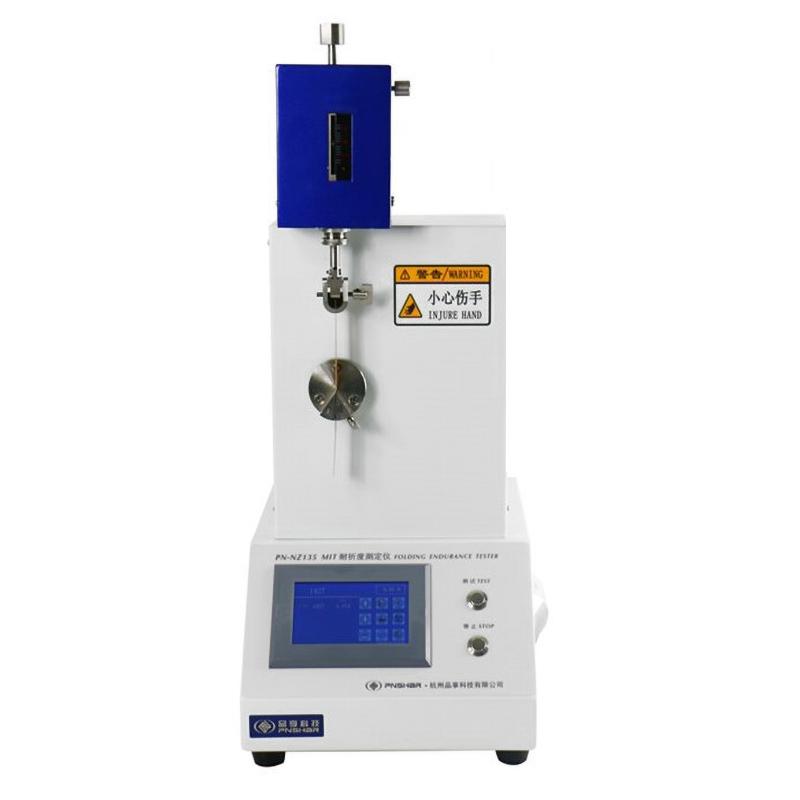
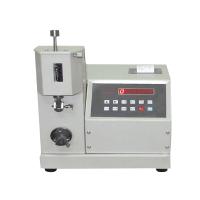
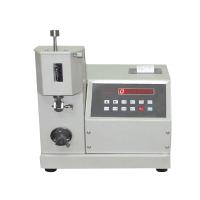
PN-NZ135 MIT folding resistance Tester is a paper folding resistance testing instrument developed according to the national standard GB/T 457 and ISO 5626, which is suitable for testing the folding resistance of paper, cardboard and other sheet materials with a thickness of less than 1.00mm.
The folding resistance refers to the logarithm of the number of double folds (with a base of 10) when the specimen breaks when tested under standard tension conditions. Fold resistance has a great impact on the shaking cover of the carton, and some cartons often have the situation of breaking the shaking cover, which affects the outer packaging of the goods.
The instrument is a mechatronics instrument. The mechanical part includes the motor transmission part and the tension mechanism part. In terms of mechanical transmission, the connecting rod is driven by the motor to control the chuck to rotate 135° to the left and right, and the speed of the motor is controlled by a governor and a circuit. The tension mechanism deforms the spring by pressing down on the tension rod, and the spring tension formed exerts force on the measured paper sample, and the tension acting on the sample is adjusted between 4.91N~14.72N. The instrument can count the number of double folds of the measured paper sample through the detection of the photoelectric circuit, and automatically stop when the sample is broken, and at the same time, the instrument also realizes the automatic homing of the folding chuck through the detection of the photoelectric circuit. It is suitable for the determination of the folding resistance of various paper and cardboard, and is a satisfactory test equipment for industries and departments such as papermaking, packaging, scientific research and product quality supervision and inspection.
Enforce the standard
GB/T 457、QB/T 1049、ISO 5626、TAPPI T511
Features
1. Mechatronics structure, simple and convenient operation, safe and reliable;
2. Fully automatic measurement, intelligent judgment function;
3. The stacking chuck of the instrument is automatically returned after each experiment, which is convenient for the next operation;
4. It has the functions of data storage, statistics, printing and so on;
5. The instrument has a compact structure, beautiful appearance and easy maintenance.
- 1Why measure the folding resistance of paper and cardboard?
- 2The principle and test method of Schopper folding resistance Tester
- 3FRANK horizontal refractometer test method
- 4Test method and principle of corrugated cardboard folding resistance meter
- 5What are the factors that affect folding endurance?
- 6What are the common mechanical performance indicators of paper?
- 7Paper properties: folding and tearing resistance
- 8Common test performance items of paper
- 9Shoeber method - determination of folding resistance of paper
- 10How to measure the folding resistance of cardboard with a Shobber Tester
- 1QB/T 1049-2004《Paper and board-Tester of folding endurance》
- 2JJG (轻工)60-2000《Schopper Type Folding Endurance Tester for Paper》
- 3JJG (轻工)59-2000《MIT Type Folding Endurance Tester》
- 4GB/T 2679.5-1995《Paper and board-Determination of folding endurance (MIT tester)》
- 5GB/T 1539-2007《Paperboard - Determination of bursting strength》
- 6QB/T 3524-1999《Relief printing paper》
- 7QB/T 2693-2005《QB/T 2693-2005》
- 8QB/T 2249-1996《Gravure printing paper》
- 9GB/T 457-2008《Paper and board - Determination of folding endurance》