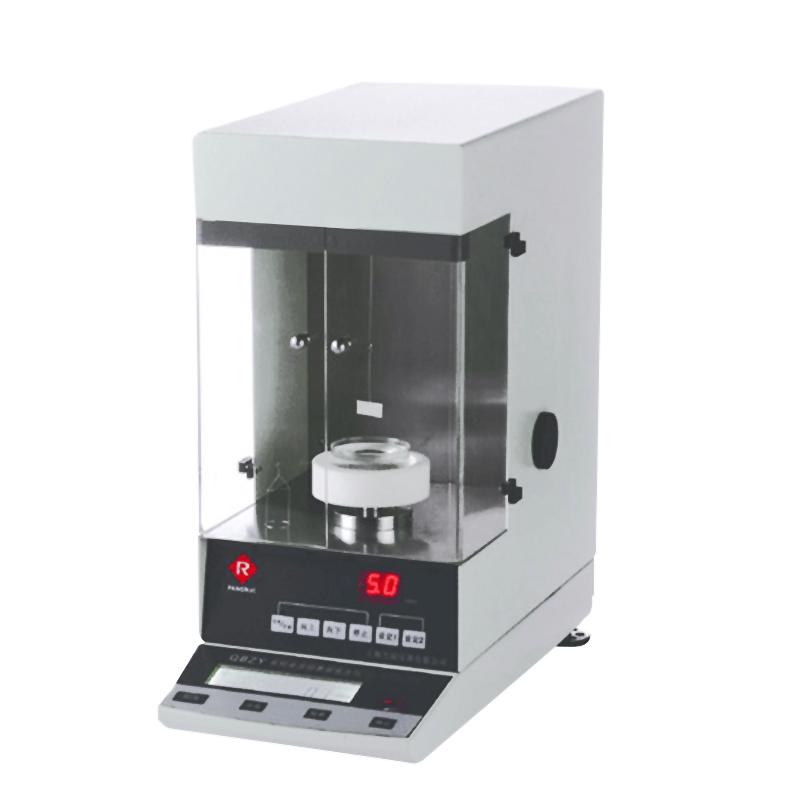


FANGRUI instrument QBZY-2 platinum plate Surface Tensiometer test range 0~400mN/m
 QBZY-2

FangRui QBZY-2 Surface TensioMeterSPEC
FangRui QBZY-2 Surface TensioMeterDetails
FangRui QBZY-2 Surface TensioMeterPacking list
- SKU
- NB029628
- Measuring method
- Platinum plate method
- Operation mode
- Automatic lifting, automatic measurement
- Measurement range of surface tension
- 0~400mN/m
- clear range
- 0~400 mN/m
- Resolution
- 0.01mN/m
- Precision
- ≤ +/- 0.04 mN/m (25 ℃ +/- 2 ℃, test secondary distillation water)
- Repeatability
- ≤±0.04mN/m
- Data Display
- When the platinum plate is tested, the displayed value is the surface tension value
- Display mode
- STN wide Viewing Angle backlight LCD display
- Measurement time
- 3-5 seconds for measurement of low viscosity sample fluids in automatic operation mode
- Temperature range
- RT or 0~100 ℃ (Glass clip cup and external Thermostatic bath are required)
- Interface
- RS232C
- Power
- AC220V, 50/60HZ
- Control mode
- Numerical control keys
- Optional
- Increase platinum ring method
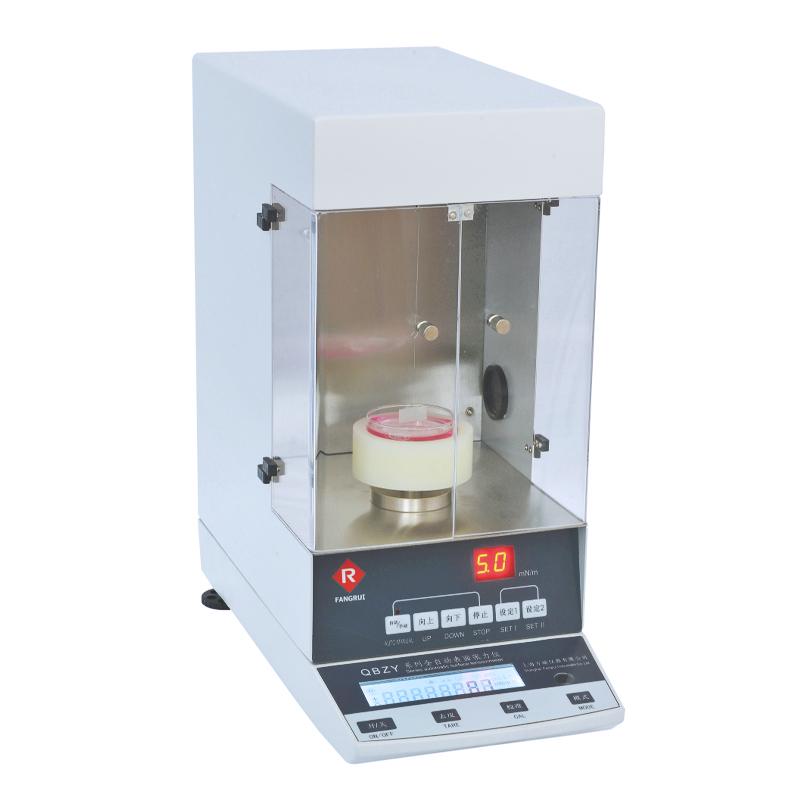
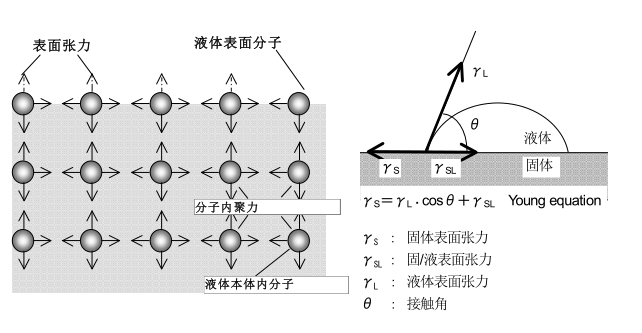
Surface tension is the basic factor that determines liquid solubility, wettability, foaming, coating and permeability. Surface tension analysis is often performed on a given liquid to study its physical behavior relative to other liquids or solids. This kind of research is the basic means of quality control in the industrialization process. FANGRUIs QBZY-2 surface tensIon Meter is a professional-grade interface chemical analysis instrument specially developed to meet users' needs for high-precision control of research and development and quality in the interface chemical testing process.
main feature
1) Both platinum plate and platinum ring testing methods can be used ( the platinum ring method needs to be purchased separately );
2) Fully automatic measurement, when testing platinum plates, the displayed value is the surface tension value;
3) When using the platinum ring test method, the displayed value automatically locks the maximum force value of the sample, and then calculates the surface tension value through the included calculation software or uses the data processing software to automatically calculate it by the computer;
4) Platinum ring size: wire radius is 0.185mm, ring radius is 9.55mm, ring circumference is 60mm;
5) Fully automatic measurement to avoid human operation errors;
6) Full-scale automatic calibration, accurate and reliable data, and excellent repeatability;
7) One-click clearing is completed instantly, and the zero position is stable without drift;
8) Adopting international professional lifting platform drive technology, no vibration and noise;
9) The instrument has a reasonable structure and works independently without any additional equipment (such as an external computer, etc.), and a computer can be optionally used for data processing;
10) When using a platinum plate, the surface tension of a liquid can be measured in real time. It is very practical for measuring samples containing surfactants or volatile substances whose surface tension changes with time (using data processing software, you can Record the test curve in real time and clearly obtain the details of the changes);
11) When using platinum plate testing, the surface tension of medium and high viscosity liquid samples can be automatically tested;
12) Both testing methods can measure the interfacial tension between immiscible liquids such as: oil/water interface;
13) Data processing software: automatically collects test curves, and the curves can be automatically enlarged, accessed, and printed. It can compare multiple test curves and automatically calculate the surface tension value when using the platinum ring method;
14) Accuracy calibration function: Using twice-distilled water and pure ethanol as standards, the overall test error of the instrument is automatically calibrated, ensuring that the instrument remains in the factory-precision state for a long time;
15) Automatic temperature compensation function: Using twice distilled water and pure ethanol as standards, samples at different temperatures can be automatically summarized to the test values ââat 20℃;
16) Comes with a variety of temperature control options to meet different testing requirements;
Instrument structure
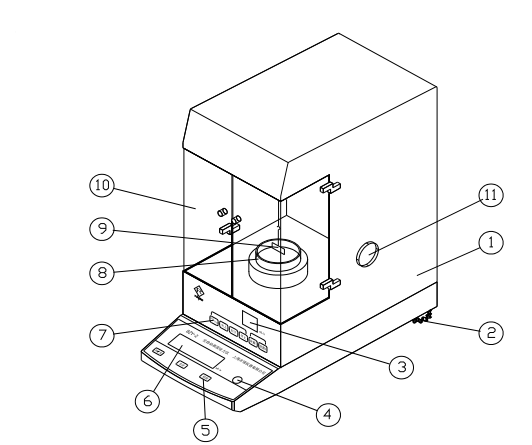
Part description: This surface tensIon Meter is mainly divided into three parts according to the operation process.
First, the sensing part mainly refers to the upper part of the instrument;
Second, the control part mainly refers to the middle and lower parts of the instrument;
Third, the display and button part mainly refers to the lower part of the instrument.
The items listed in the above components refer to:
1. Surface Tensiometer host;
2. Level adjustment feet;
3. Setting value display
4. Level (bubble calibrator)
5. Switch, tare subtraction, correction key, mode key
6. LCD display (displays the measured value part)
7. Main control buttons
8. Automatic lifting and lowering of sample stage
9. Hooks and platinum plates
10. Plexiglass door
11. Thermostatic water pipe hole
Detection principle
platinum plate method
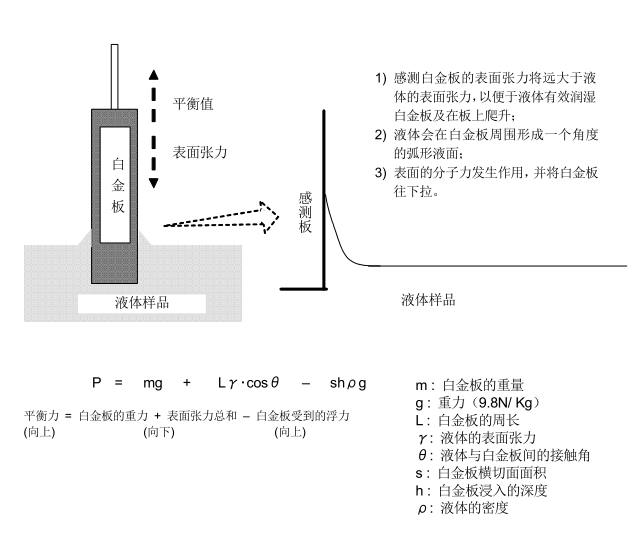
When the sensing platinum plate is immersed in the liquid to be measured, the surface tension around the platinum plate will be exerted. The surface tension of the liquid will pull the platinum plate down as much as possible. When the surface tension of the liquid and other related forces and balancing forces reach equilibrium , the sensing platinum plate will stop immersing into the liquid. At this point, the instrument's balance sensor measures the immersion depth and converts it into a surface tension value for the liquid. In the specific testing process, the testing steps of the platinum plate method are:
(1) Gradually immerse the platinum plate into the liquid;
(2) When immersed in the liquid surface, the balance value is sensed by the sensor;
(3) Convert the sensed equilibrium value into a surface tension value and display it.
Platinum Tour de France
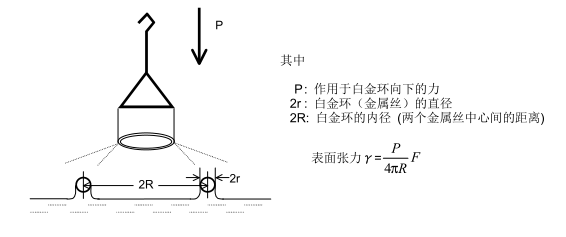
Because it is widely used in the du Nou Surface Tensiometer, this method is also called the du Nouy method and is widely used because of its easy operation . The name platinum ring method is derived from the formation of a ring between the test part and the liquid sample . The measurement method of the platinum ring method is:
(1) Gently immerse the platinum ring into the liquid;
(2) Then slowly lift the platinum ring upward at about 5mm to 6mm , that is, the liquid level decreases relatively, causing a liquid column to form under the platinum ring, and finally separate from the platinum ring. The platinum ring method is to sense a maximum value, and this maximum value is formed when the platinum ring and the liquid sample are about to separate but not separated. The accuracy with which this maximum value is converted into a surface tension value depends on the viscosity of the liquid.
Application scope
- Ink, printing ink and paint industry: analyze the wettability of printing/coating processes, conduct product development and quality control
- Printing industry: development of screen cleaning fluid and wettability analysis, film wettability analysis
- Film industry: wettability analysis, quality control
- Cleaning agent industry: analyze the absorption speed and properties of surfactants and study appropriate concentrations
- Chemical additive industry: research on aggregation and diffusion behavior capabilities
- Cosmetics industry: analysis of dispersion, stability and wettability of emulsions or suspensions
- Electroplating industry: analyze the surface tension of electroplating liquid and conduct quality control
- Pesticide industry: additive development, formulation, wettability analysis
- Nanofiber and powder research: fiber contact angle/hydrophilicity angle analysis, dynamic contact angle analysis
- Petroleum industry: tertiary oil recovery interfacial tension characterization, oil flooding quality control, degradable component analysis
- Textile industry: contact angle analysis, dye wettability, surface tension, adhesion analysis
- , Food industry: surface tension and wettability analysis, can coating surface tension and cleanliness analysis
- Electric power industry: surface tension analysis of transformer oil and insulating oil, fiber bundle contact angle analysis
- 1What is surface tension?
- 2Comparison of Fangrui's different series of automatic watch interfacial tensIon Meters
- 3What are surface tension, contact angle, hydrophilic and hydrophobic surfaces?
- 4Application principle and precautions of platinum ring Surface Tensiometer