
PORUIKE HL200 Leeb Hardness Tester
 HL200
HL200

PoRuiKe HL200 Leeb Hardness TesterSPEC
PoRuiKe HL200 Leeb Hardness TesterDetails
PoRuiKe HL200 Leeb Hardness TesterPacking list
- SKU
- NB029799
- Measurement range
- 30.6~102.6HS、170~960HLD、19~651HB、13.5~101.7HRB、17.9~69.5HRC、59.1~88HRA、80~1042HV
- Measurement direction
- 360 ° (vertical down, diagonal down, horizontal, diagonal up, vertical up)
- Measurement material
- Steel and cast steel, alloy tool steel, stainless steel, gray cast iron, ductile cast iron, cast aluminum alloy, copper zinc alloy (brass), copper tin alloy (bronze), pure copper, wrought copper
- Error of indication
- ±6HLD
- Indication Repeatability
- ±6HLD
- Hardness system
- HL/HB/HRC/HRA/HV/HS
- Upper and lower limit setting range
- 170~960HLD
- Display
- Highlight OLED128x64 dot matrix display
- Indication calibrated
- Adjustment with indication software
- Data storage
- Maximum 600 Groups (Impact 32~ 1)
- Communication interface
- RS232
- Working time
- About 100 hours
- working language
- Chinese
- Dimensions
- 132 * 82 * 33Mm (host)
- Weight
- 0.6KG (host)
Overview
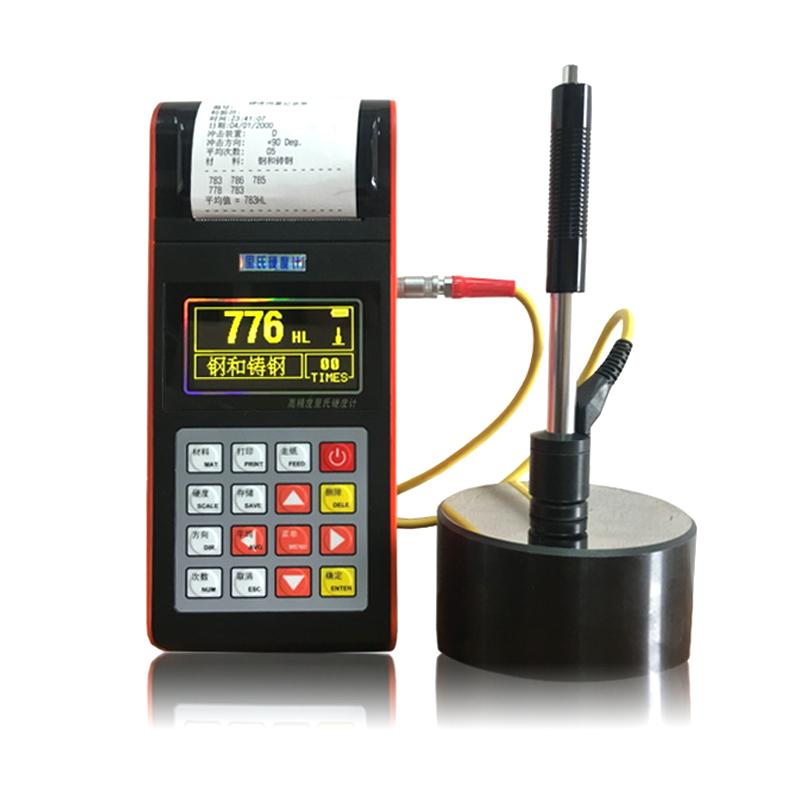
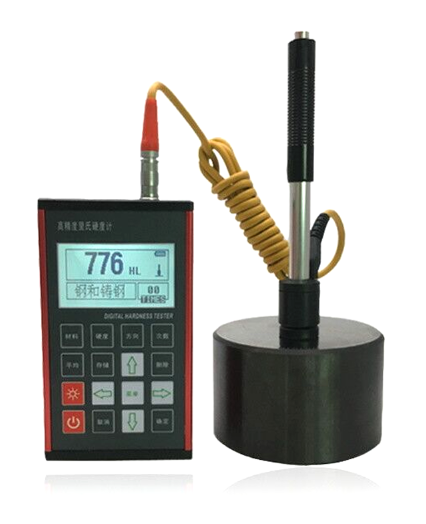
HL-200 Metal Case Portable Leeb Hardness Tester (Rugged Type) adopts the Leeb hardness measurement principle, which is suitable for hardness measurement of most materials, convenient for user test results, especially suitable for outdoor hardness testing, and is a portable Hardness Tester with high cost performance. The instrument is designed with a streamlined ergonomic structure, comes with a standard stand, and features a large OLED 128×64 dot matrix display for an informative and intuitive look. No dead ends, easy to operate and read.
Applicable Materials: Steel & Cast Steel, Alloy Tool Steel, Stainless Steel, Gray Cast Iron, Ductile Iron, Cast Aluminum Alloy, Copper-Zinc Alloy (Brass), Copper-Tin Alloy (Bronze), Pure Copper, Forged Steel.
Features
Based on the Leeb hardness principle, a wide range of metal materials can be detected with high precision.
The "Steel" material is supported, and when the "Forged Steel" specimen is tested with a D/DC type impact device, the HB value can be read directly, eliminating the need to manually check the table.
It is convenient to switch to all hardness systems (HL, HB, HRB, HRA, HRC, HV, HS) and convert the measured values of each hardness system in parallel
Adopt a large-screen 128×64 graphic dot matrix LCD display, which is informative and intuitive.
Full Chinese display, menu-based operation, simple and convenient operation.
It has a bright backlit display, which is convenient for use in low-light environments.
RS232 communication interface, which can easily and quickly exchange data and set parameters with PC.
One main unit can be equipped with 7 different impact devices, and the type of impact device can be automatically identified. There is no need to recalibrate when replaced.
It can store up to 600 sets of hardness measurement data (impact times 32~1). Each set of data includes information such as a single measurement, an average value, the date of measurement, the direction of impact, the number of times, the material, the hardness system, etc.
The upper and lower limits of hardness values can be set in advance, and automatic alarms will be given when the range is exceeded, which is convenient for users to test in batches.
Compact, portable, and highly reliable enclosure for harsh operating environments, resistant to vibration, shock, and electromagnetic interference.
The power supply adopts 2 AA (No. 5) ordinary alkaline batteries, which have power-saving functions such as automatic sleep and automatic shutdown.
There is a residual power indicator icon on the LCD, prompting the user to replace the battery in time.
It has the function of calibration of the indicator software
The design is based on the standard: "Technical Conditions for Leeb Hardness Tester" JB/T 9378-2001.
Applications
In the machining industry, it is particularly suitable for on-site hardness testing of large parts and non-detachable parts
Hardness of installed mechanical or permanent assembled parts.
Mold cavity hardness.
Hardness of heavy workpieces
Failure analysis of pressure vessels, turbine-generator sets and their equipment
The hardness of the workpiece with a very small experimental space
Hardness of bearings and other parts
Material division of metal material warehouse
Rapid detection of multiple measuring parts in a large area of large workpieces
Operating Conditions
Operating temperature: -10°C~+55°C
Stable storage -20°C~+75°C
Relative Humidity: ≤90%
There is no strong vibration, no strong magnetic field, no corrosive medium and no serious dust in the surrounding environment