
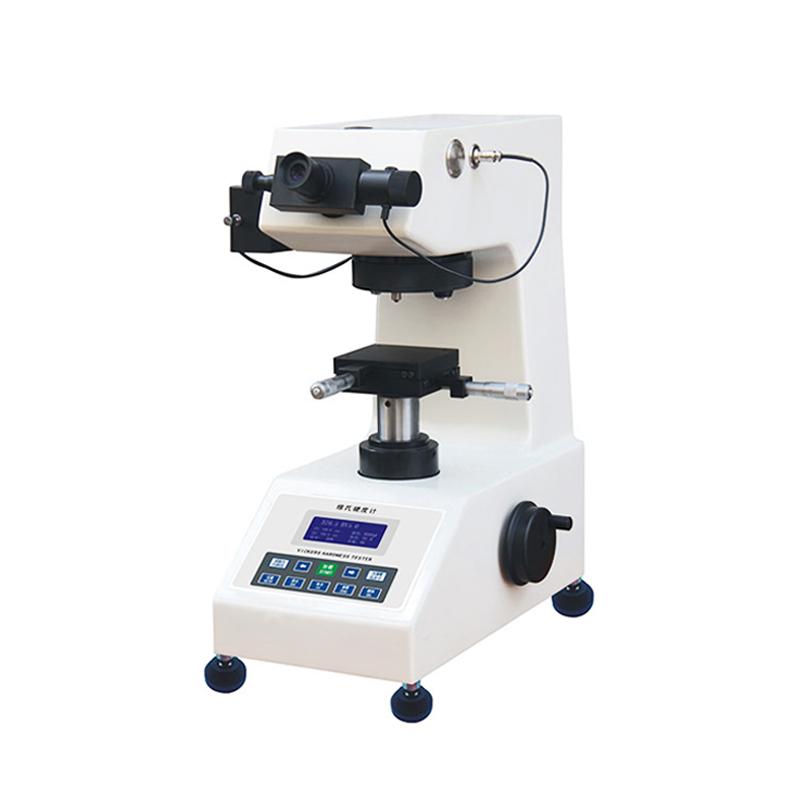
PORUIKE HV-1000A Microscopic Vickers Hardness Tester
 HV-1000A

PoRuiKe HV-1000A Vickers Hardness TesterSPEC
PoRuiKe HV-1000A Vickers Hardness TesterDetails
PoRuiKe HV-1000A Vickers Hardness TesterPacking list
- SKU
- NB029994
- Machine Weight
- 36kg
- Dimensions
- 433*228*523mm
- Power
- AC220V/50~60Hz
- Display
- LCD display
- The maximum distance from the center of the indenter to the machine wall
- 98mm
- Test force holding time
- 0-60s
- Maximum height of applicable material
- 100mm
- Measurement unit
- 0.0625mm
- Microscope magnification
- 400X (during testing) X100 (during observation)
- Loading method
- manual
- Indenter and objective lens conversion method
- manual
- Hardness symbol
- HV1、HV5、HV10、HV20、HV30、HV50
- Measurement range
- 1HV~2967HV
- test force
- 10/25/50/100/200/300/500/1000gf
Introduction
The Perrick HV-1000A micro-Vickers Hardness Tester presses the surface of the workpiece, and then uses a reading microscope to measure the length of the diagonal of the indentation. Finally, it is measured using a conversion relationship between the diagonal and the test force. Vickers hardness. It is mainly used to test the hardness of small precision parts, the hardness of the surface hardened layer and the depth of the effective hardened layer, the surface hardness of the coating, the hardness of sheet materials and thin wires. It is equipped with an automatic turret device, with stable performance, solid structure and high reliability. The operation is simple, the test process is controlled by the CPU, and it is equipped with high-definition optical measurement system, photoelectric sensing and other new technologies, and uses computer-assisted means to achieve powerful functions. It is widely used in hardware processing, electronics industry, engineering quality inspection and other fields. It is an ideal hardness testing instrument for material testing in scientific research institutions, processing manufacturing and quality inspection departments.
Features
1. The Hardness Tester adopts a quiet design mechanically, the test process is controlled by the CPU electrically, and new technologies such as high-definition optical measurement system and photoelectric sensing are used optically.
2. The operation is input by the touch keys on the panel, which can preset the test force dwell time, select the Vickers or Knoop test method, adjust the intensity of the measurement light source, etc.
3. Can display the measured indentation length, hardness scale, number of measurements, etc. on the LCD.
4. It is suitable for measuring small and thin specimens and parts after surface penetration treatment. It can measure the micro-Vickers and Knoop hardness of brittle materials such as agate, glass, ceramics, etc. It is suitable for scientific research units, colleges and universities, and manufacturers. The ideal hardness testing instrument for research and testing by enterprises and testing institutions
The main purpose
It is mainly used for small-load Vickers hardness tests in materials research and scientific experiments. It is mainly used to test the hardness of small precision parts, the hardness of surface hardened layers and the depth of effective hardened layers, the surface hardness of coatings, the hardness of sheet materials and thin wires, and blades. Nearby hardness, hardness of dental materials, etc. Micro-Vickers hardness test is mainly used in metallurgical and metallographic research, used to measure the hardness of each component phase in the metal structure, and used to study the brittleness of refractory compounds, etc. Micro-Vickers hardness test is also used to test extremely small or extremely thin parts, and the thickness of the parts can be as thin as 3μm.
It is also widely used to measure the microhardness of tiny, thin specimens, surface coatings and other specimens and to determine the Knoop hardness of brittle and hard materials such as glass, ceramics, agate, artificial gemstones, etc. It is an ideal choice for scientific research institutions and factories. It is a perfect hardness testing instrument for material research and testing by the quality supervision department. Application: heat treatment, carbonization, quenching hardened layer, surface coating, steel, non-ferrous metals and small and thin parts, etc. Equipped with a Knoop indenter, it can measure the Knoop hardness of brittle and hard materials such as glass, ceramics, agate, and artificial gemstones.
Operating Conditions
Operating temperature: 10℃ï½35℃;
Relative Humidity: â¤65%;
In an environment without vibration and corrosive media around;
Install horizontally on a solid foundation.