
DRICK DRK103 whiteness Color instrument
 DRK103


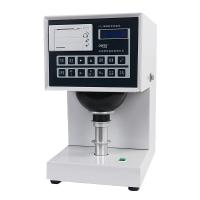
Drick DRK103 Whiteness Color MeterSPEC
Drick DRK103 Whiteness Color MeterDetails
Drick DRK103 Whiteness Color MeterPacking list
- SKU
- NB034304
- Analog D65 lighting body lighting
- Adopt CIE 1964 to supplement chroma system and CIE 1976 (L * a * b) color space Color difference formula
- Geometry conditions observed with D/O illumination
- Diffuse ball diameter 150MM, test hole diameter 25MM
- Repeatability
- δ(Y10)<0.1,δ(X10.Y10)<0.001
- Precision
- △Y10<1.0,△X10(Y10) <0.01.
- Specimen size
- The test plane is not less than Should 30MM, thickness is not more than 40MM
- Power Supply
- AC220V±5%,50Hz,0.3A
- Operating Environment
- Temperature 10~30 ℃, Relative Humidity does not exceed 85%
- Dimensions
- 300×380×400mm
- Weight
- 15KG
Introduction
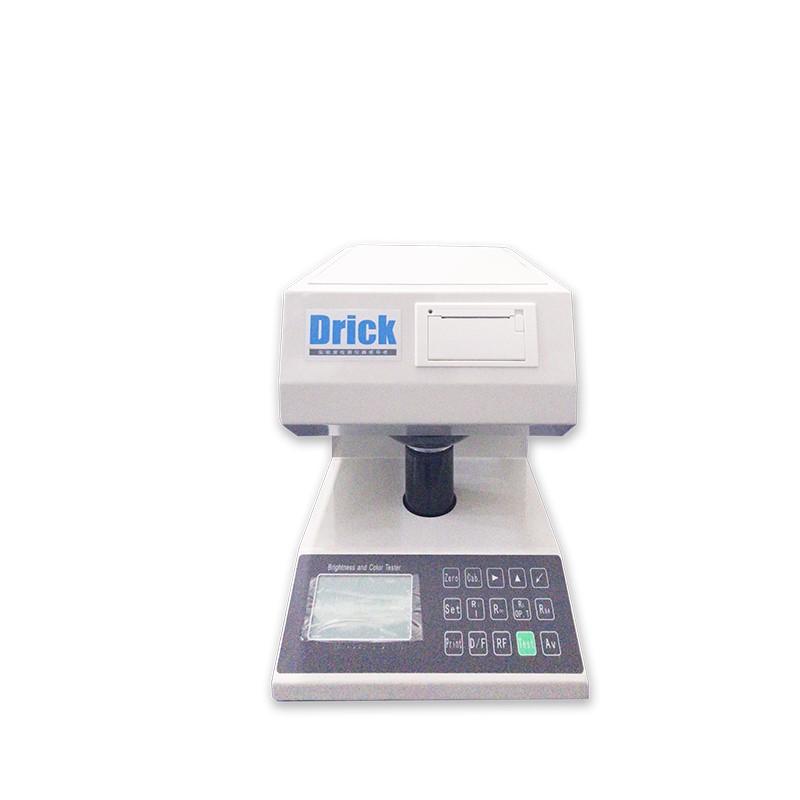
DRK103 whiteness colormeter, also known as Colorimeter, whiteness Colorimeter, whiteness colormeter, etc., can be widely used in papermaking, printing, ceramics, chemical, textile printing and dyeing, building materials, grain, salt and other industries, used to determine the whiteness, yellowness, color and color difference of objects.
Features
The instrument adopts optical, mechanical, electrical integration and microcomputer measurement and control technology, has the function of statistical processing of test data, can be printed, and can measure the whiteness (brightness) and chromaticity of various objects.
1. Measure the color of the object, report the diffuse reflection factor RX, RY, Rz, stimulus value X10, Y10, Z10, color coordinates X10, Y10, brightness L*, chromaticity a*, b*, chroma C*ab, hue angle h*ab, main wavelength λd, excitatory purity Pe, chromatic aberration ΔE*ab, brightness difference ΔL*, chromaticity difference ΔC*ab, hue difference ΔH*ab, Hunter system L, a, b;
2. Determination of yellowness YI;
3. Determine opacity OP;
4. Measure the light scattering coefficient S;
5. Measure the light absorption coefficient A;
6. Measure transparency;
7. Determine the ink absorption value;
8. The reference sample can be a physical object or a data. The instrument can store and memorize up to 10 reference sample information;
9. The average value can be taken for multiple measurements, and the measurement results can be printed and reported digitally;
10. The instrument has a memory function. Even if the power is lost for a long time, useful information such as zeroing, calibration, and the magnitude of standards and reference samples will not be lost.
Applications
1. Measure the color and color difference reflected by the object;
2. Measure ISO brightness (blue light whiteness R457) and fluorescence whitening of fluorescent whitening materials;
3. Measure CIE whiteness (Gantz whiteness W10 and color cast value TW10);
4. Measure the whiteness of building materials and non-metallic mineral products;
5. Measure yellowness;
6. Measure the opacity, transparency, light scattering coefficient and light absorption coefficient of the sample;
7. Measure the ink absorption value.
Technical standards
GB 7973: Pulp, paper and cardboard diffuse reflection factor determination method (d/o)
GB 7974:Determination of whiteness of paper and cardboard (d/o)
GB 7975:Paper and cardboard color determination method (d/o)
ISO 2470: Method for Determining the Diffuse Reflectance Factor of Blue Light on Paper and Cardboard (ISO Whiteness)
GB 3979: Methods for measuring object color
GB 8940.2: Pulp whiteness determination method
GB 2913: Test methods for the whiteness of plastics
GB 1840: Methods for the determination of industrial potato starch
GB 13025: General test method for salt industry, determination of whiteness, textile industry standard: Determination method of pulp whiteness for chemical fibers GB T/5950: Measurement method for whiteness of building materials and non-metallic mineral products
GB 8425: Methods for instrumental evaluation of the whiteness of textiles
GB 9338: Method for determining the whiteness of fluorescent brighteners
GB 9984.1: Determination of whiteness of industrial sodium tripolyphosphate
GB 13176.1: Test method for whiteness of laundry detergent
GB 4739: Methods for determining the color of ceramic pigments for daily use
GB 6689: Instrumental method for the determination of dye chromatic difference
GB 8424: Methods for determining the color and color difference of textiles
GB 11186.1: Method for measuring the color of coating films
GB 11942: Methods for measuring the color of colored building materials
GB 13531.2: Determination of cosmetic color tristimulation value and color difference △E*
GB 1543: Determination of the opacity of paper
ISO2471: Paper and cardboard opacity determination
GB 10339: Determination of light scattering coefficient and light absorption coefficient of paper and pulp
GB 12911: Determination of the absorptivity of paper and cardboard inks
GB 2409: Test method for yellow index of plastics