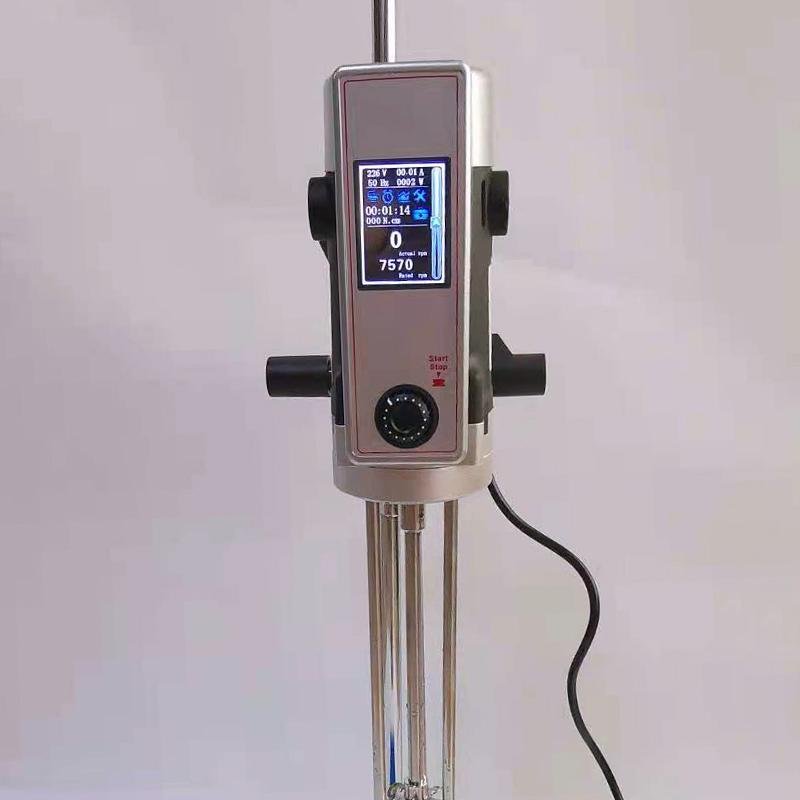
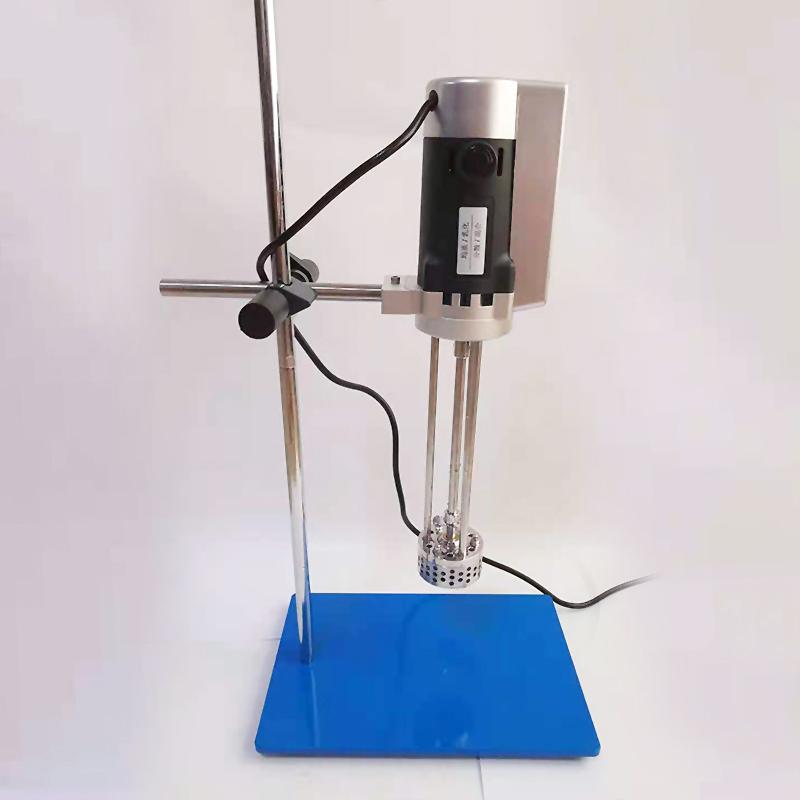
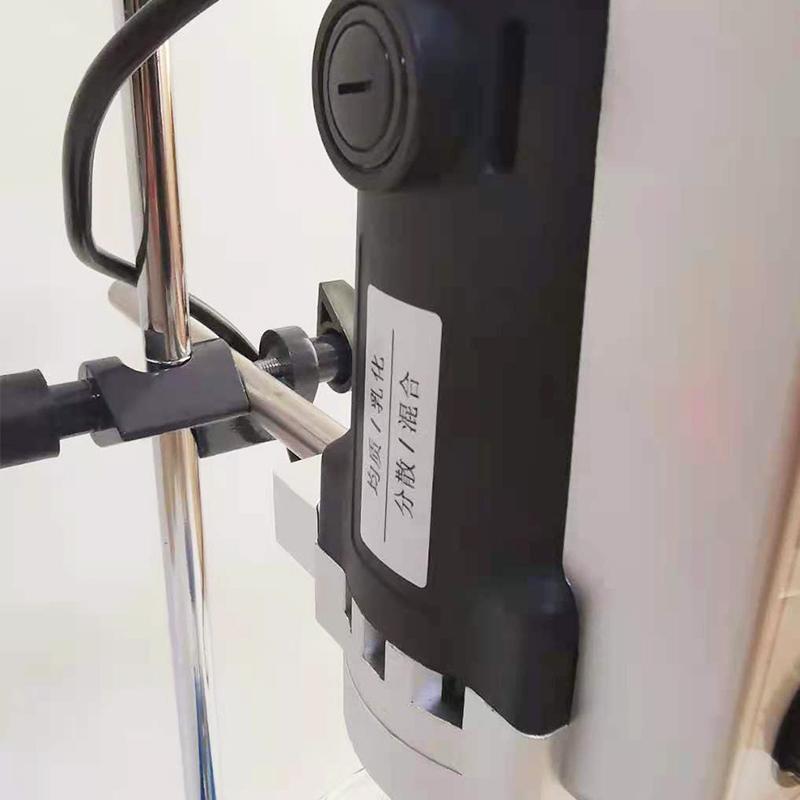
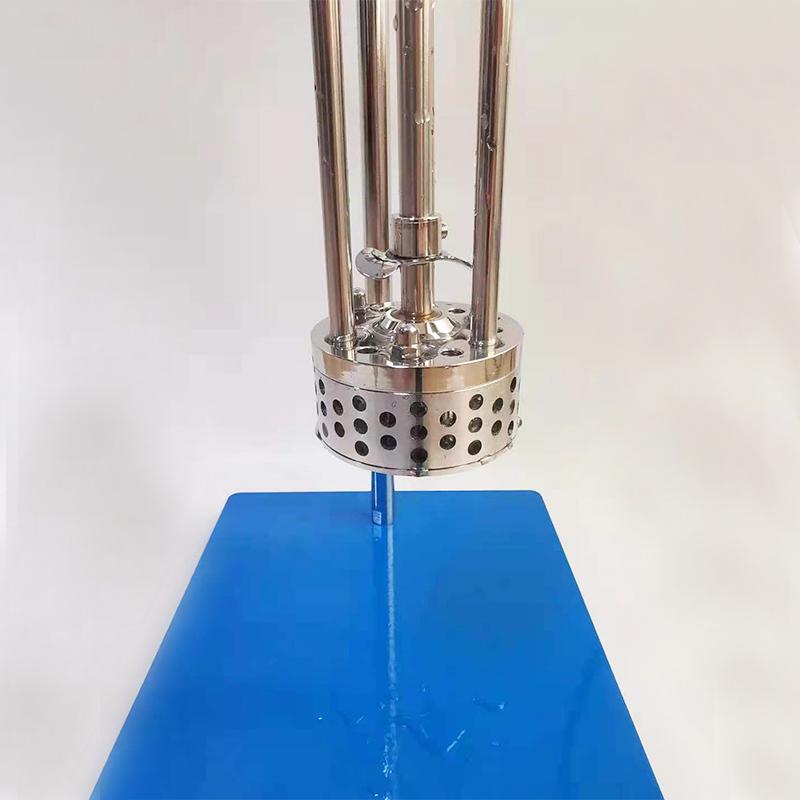

MUXUAN ZN500-90 laboratory high shear Mulser three-core processor, intelligent control main board 800W
SE ZN500-90

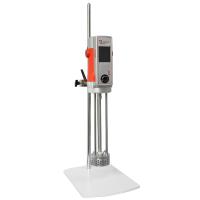
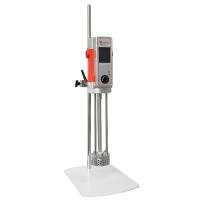
MuXuan ZN500-90 Laboratory High Shear MulserSPEC
MuXuan ZN500-90 Laboratory High Shear MulserDetails
MuXuan ZN500-90 Laboratory High Shear MulserPacking list

- SKU
- NB034824
- Rated Voltage
- AC 220V 50/60 Hz
- output power
- 800W
- Speed range
- 1000~12000rpm
- Rotation speed display
- TFT-LCD
- Timer
- 1-1000 min
- Rotation speed dynamic detection function
- Yes
- Overload protection
- Yes
- Real-time torque Linear dispersion display
- Yes
- Real-time Voltage, Current, Frequency, Power Display
- Yes
- Rotor maximum linear velocity
- 22m/s
- Work head material
- Stainless steel 304/316L #
- Work head specification
- Φ90 mm
- Maximum immersion liquid height
- 50mm
- Stator standard configuration
- round hole, one long hole working head each.
- Processing Capacity
- 800~30000mL
- Max. Processing Viscosity
- 8000 cp
- Ambient Temperature
- Not more than 40 ℃
- Allowable Relative Humidity
- Not more than 80%
- Dimensions
- 215*310*720 mm
- Machine Weight
- About 11kg
- Minimum immersion liquid height
- 50mm

Equipment introduction
The laboratory homogenizing emulsifier is a piece of laboratory equipment designed for laboratory micro-experiments. Through the action of mechanical external force, the particle size of liquid-liquid and solid-liquid materials is narrowed, so that one phase is evenly distributed into another or multiple phases to achieve the effects of refinement, homogenization, dispersion and emulsification, thereby forming a stable The state of liquid-liquid and solid-liquid dispersion systems. Can be equipped with a variety of working heads of different specifications
Application scope
[Material viscosity]: â¤8000 cps (mPas)
[Application fields]: Suitable for dispersion, emulsification and homogenization of product materials in industries such as biology, food, coatings, inks, textile auxiliaries, cosmetics, lubricants, pesticides and other industries.
[Applicable materials]: Solids and liquids, liquids and liquids can be mixed to form solutions, colloids, suspensions or emulsions; such as juices, soups, dairy products, tissue homogenates, cosmetics, surfactants, Asphalt, emulsifiers, oil field chemicals and other materials.
Applicable process
It is suitable for dispersing, homogenizing, emulsifying, crushing, polymerizing, suspending and dissolving materials with medium viscosity and above.
Features
Triple-core processor intelligent control motherboard, 2.8-inch TFT true color touch screen, real-time Voltage, frequency, current, and power display. Equipped with a torque curve display, the experimental data is more stable, and it has overload and overcurrent protection, local self-test, timing, memory and other functions. The speed can be preset and paused at any time. The speed is digitally displayed and easy to operate.
Principle
The powerful motor of the laboratory homogenizing emulsifier rotates at high speed to form a vacuum between the rotor and stator, and the material is sucked in from the upper and bottom of the rotor and stator. The strong kinetic energy causes the rotor to generate a high linear speed, causing the material to fly out after strong impact, crushing, centrifugal extrusion, liquid layer friction, and shearing between the rotor and the stator. Under the action of a variety of forces in different directions , producing strong turbulence. With an appropriate amount of emulsifier and mature technology, the material undergoes repeated cycles of depolymerization, dispersion, homogenization, refinement, and shearing for a certain period of time to produce a stable emulsion.