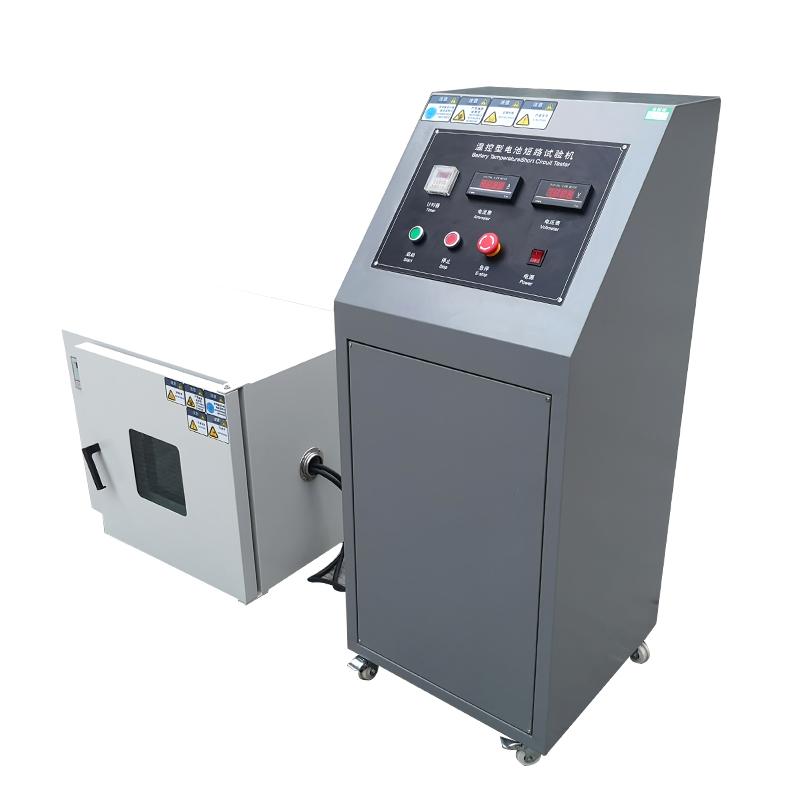
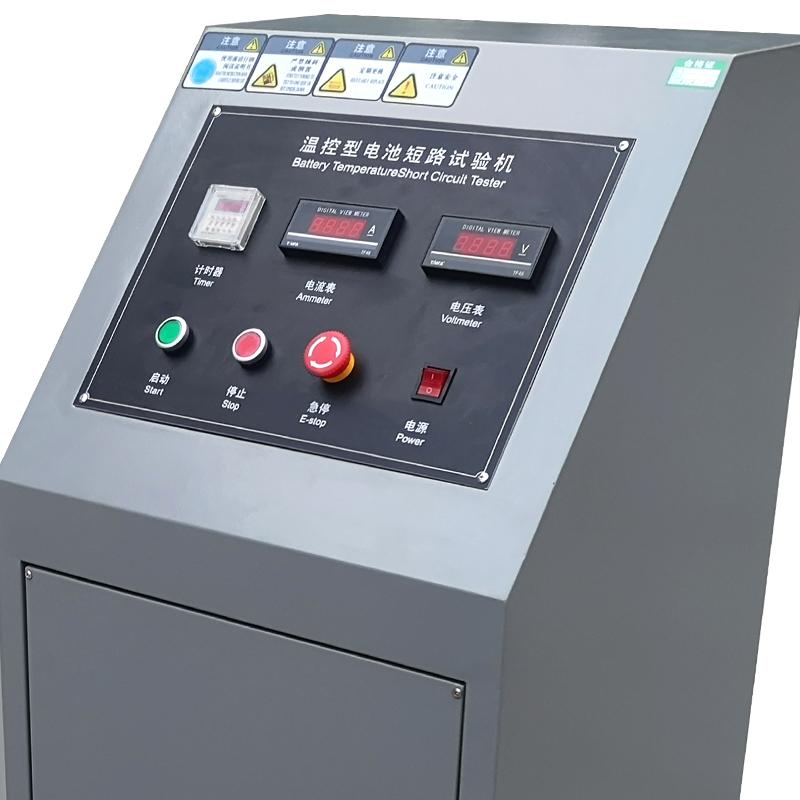
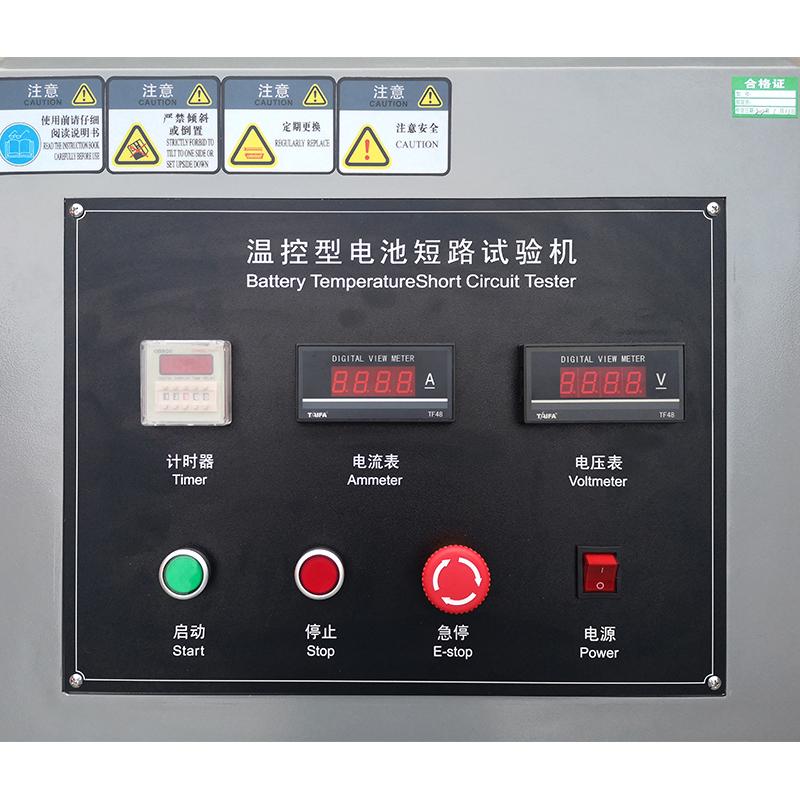

ASR-9010 controlled battery short circuit Tester, room temperature~ 150 ℃
 ASR-9010

AISRY ASR-9010 Temperature controlled battery short circuit testing machineSPEC
AISRY ASR-9010 Temperature controlled battery short circuit testing machineDetails
AISRY ASR-9010 Temperature controlled battery short circuit testing machinePacking list

- SKU
- NB042267
- Control method
- PLC touch screen Control system (with remote control)
- Voltage
- 0-100V
- short circuit current
- 0-1000A
- Temperature control box temperature control
- Room temperature~ 150 ℃
- Temperature transducer
- -20℃~ 130℃
- Temperature control Accuracy
- 0.1℃
- Temperature Uniformity
- ±1℃
- Temperature control explosion-proof box measurement space
- 450X450x350mm (can be customized)
- Working Voltage
- AC 220V 50Hz~ 60Hz
- impulse Voltage
- AC 1kv/1.2-50μs(峰值)1min
- DC response time
- ≤ 5 μs
- Device internal resistance
- 80 ± 20mΩ (load current 400A)
- Action time
- Pucking time/release time ≤ 30ms
- Action characteristics
- Cold pull-in Voltage ≤ 66% Us
- Cold release Voltage
- ≯30%Us,≮5%Us
- Exhaust fan
- 100mm diameter exhaust pipe protrudes out at the rear
- Complementary trend
- There are two 50mm diameter trends on the left side of the box (can also be used for Voltage measurement, etc.)
- Window size
- 300 * 300mm, Film thickness 20mm tempered Explosion-proof Glass
- Weight
- About 100Kg
- Power
- AC220V,50/60Hz
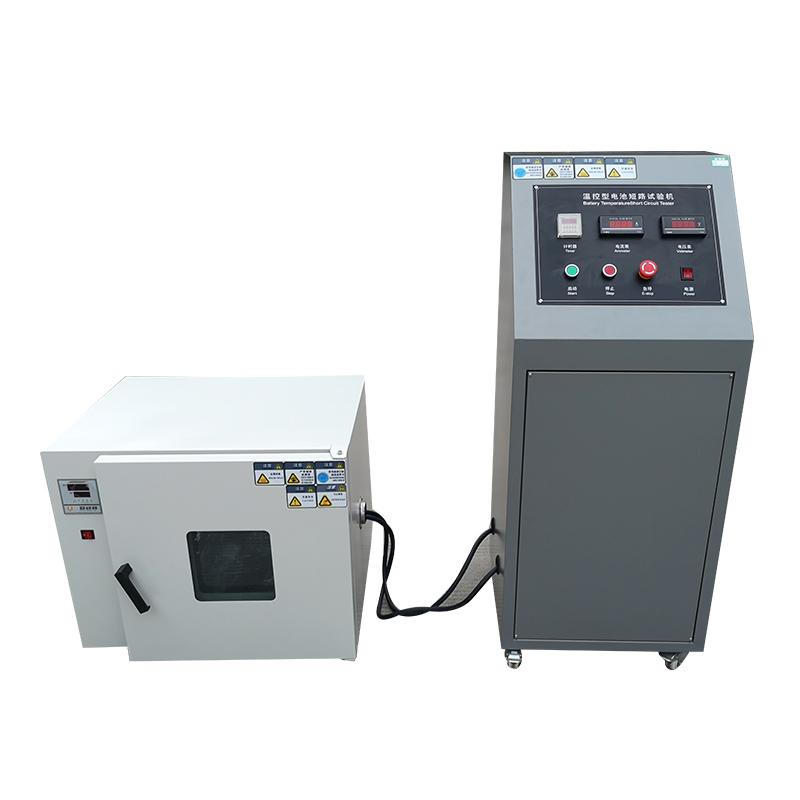
product description
The temperature-controlled battery short-circuit Tester is designed based on the requirements of various battery short-circuit test standards. According to the standard requirements, the short-circuit device must meet the internal resistance range ≤ 5mΩ, so as to obtain the maximum short-circuit current required by the test; in addition, the circuit design of the short-circuit device must also be It can withstand the impact of high current, so we have selected industrial-grade DC electromagnetic contactors, all-copper terminals and internal copper plates for current conduction. The wide and thick copper plates can effectively improve the heat dissipation effect, make the high-current short-circuit device safer, and effectively reduce the loss of test equipment. , to ensure the accuracy of the test data.
The short-circuit testing machine adopts PLC automatic control to simulate the external short-circuit of the battery, and meets the standards of UL1642, UN38.3, IEC62133, GB/T18287, GB/T 31241-2014 and so on. Record battery Voltage, current and surface temperature changes. The short-circuit testing machine requires the resistance of the entire circuit (including circuit breaker, wires and connecting devices) to be 80±20mΩ, and each circuit can withstand a peak short-circuit current of 1000A. Short-circuit stop mode can be selected: 1. Short-circuit time; 2. Battery surface temperature.
Standards
GB 31241-2014 "Safety Requirements for Lithium-ion Batteries and Battery Packs for Portable Electronic Products"
MT/T 1051-2007 "Lithium-ion batteries for miner's lamps"
SJ/T 11169-1998 (UL1642: 1995) "Safety Standards for Household and Commercial Batteries"
YD 1268-2003 "Safety Requirements and Test Methods for Lithium Batteries and Chargers of Mobile Communication Handsets"
GB/T 19521.11-2005 "Safety Code for Inspection of Hazardous Properties of Lithium Battery Pack Dangerous Goods"
GB/T 18287-2013 "General Specification for Lithium-ion Batteries for Cellular Phones"
SJ/T 11170-1998 (UL2054: 1997) "Safety Standards for Household and Commercial Batteries"
UN 38.3 "Recommendations on the Transport of Dangerous Goods - Manual of Tests and Criteria", Part III, Section 38.3
UL 1642 "Lithium Battery Standard" 2054 "Household and Commercial Battery Packs"
IEC62133-2012 "Battery cells and battery packs containing alkaline or non-acid electrolytes - Safety requirements for sealed batteries and battery packs for portable equipment"
GB/T 8897.4-2008 (IEC 60086-4:2007) "Primary Battery Part 4 Safety Requirements for Lithium Batteries"
YDB 032—2009 "Communication backup lithium-ion battery pack"
YD/T 2344.1—2011 "Lithium Iron Phosphate Battery Pack for Communication Part 1: Integrated Battery Pack"
GB/T 21966-2008 (IEC 62281:2004) "Safety Requirements for Lithium Primary Batteries and Storage Batteries in Transport"
Test standard requirements
After the battery is fully charged according to the specified test method, place it in an environment of 55°C ± 5°C, and wait for the battery temperature to reach 55°C ± 5°C, and then place it for 30 minutes. Then connect the positive and negative terminals of the battery with wires, and ensure that the total external resistance is 80mΩ±20mΩ. During the test, the temperature change of the battery is monitored. When one of the following two situations occurs, the test is terminated.
1) The battery temperature drops to 20% lower than the peak value;
2) The short-circuit time reaches 24h;
3) Test results: The battery should not catch fire or explode, and the maximum temperature should not exceed 150°C.