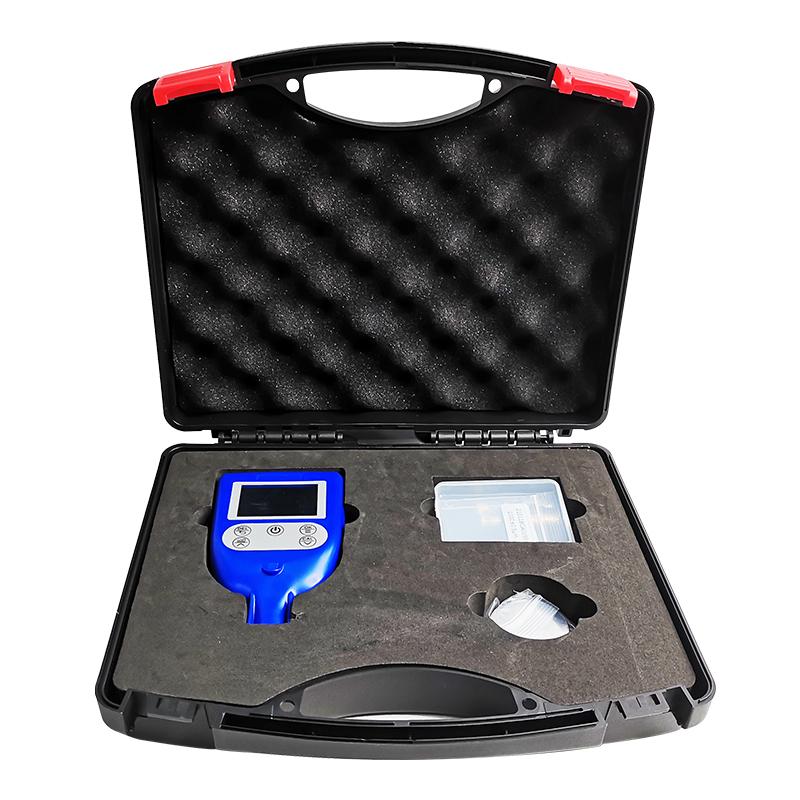

LEEB Leeb252C Metal Coating Thickness Gauge magnetic Induction/eddy Current Range 0~1500μm
 Leeb252C

-
 CHINA CTG-800-1500FN Paint Layer Thickness Gauge, Integrated dual-use Standard Type$ 206.00SE
 -
 Defelsko PosiTector 6000 FNS1 coated platings Thickness Gauge that automatically converts in magnetic and nonmagnetic environments$ 1432.00SE
 -
 Defelsko PosiTector 6000 FNS3 Coating Thickness Gauge metal substrate Automatic substrate type identification and measurement$ 1937.00SE
 -
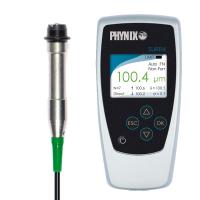 PHYNIX Surfix SX-FN1.5 dual-use Coating Thickness Gauge 1500μm
 -
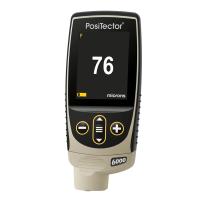 Defelsko PosiTector 6000 FN1 Coating Thickness Gauge for automatic substrate type and measurement$ 1299.00SE





Leeb Leeb252C Coating Thickness GaugeSPEC
Leeb Leeb252C Coating Thickness GaugeDetails
Leeb Leeb252C Coating Thickness GaugePacking list

- SKU
- NB043854
- Probe type
- F1/N1
- Measurement principle
- Magnetic Induction/eddy Current
- Measurement range
- 0~1500μm
- Low resolution
- Below 100um 0.1um, above 100um 1um
- An indication of zero calibrated error
- ±(3%H+1)
- An indication of two-point calibrating error
- ±[(1~3%)H+1]
- Minimum radius of curvature
- Convex 1.5mm, Concave 3mm
- minimum area diameter
- Φ7mm/Φ5mm
- Basic critical thickness
- 0.5mm/0.3mm
- temperature
- 0~40℃
- Humidity
- 20%~90%
- Power Supply
- AA type alkaline battery 1.5V two
- Dimensions
- 112 * 70 * 23Mm (host)
- Weight
- Approx. 80g
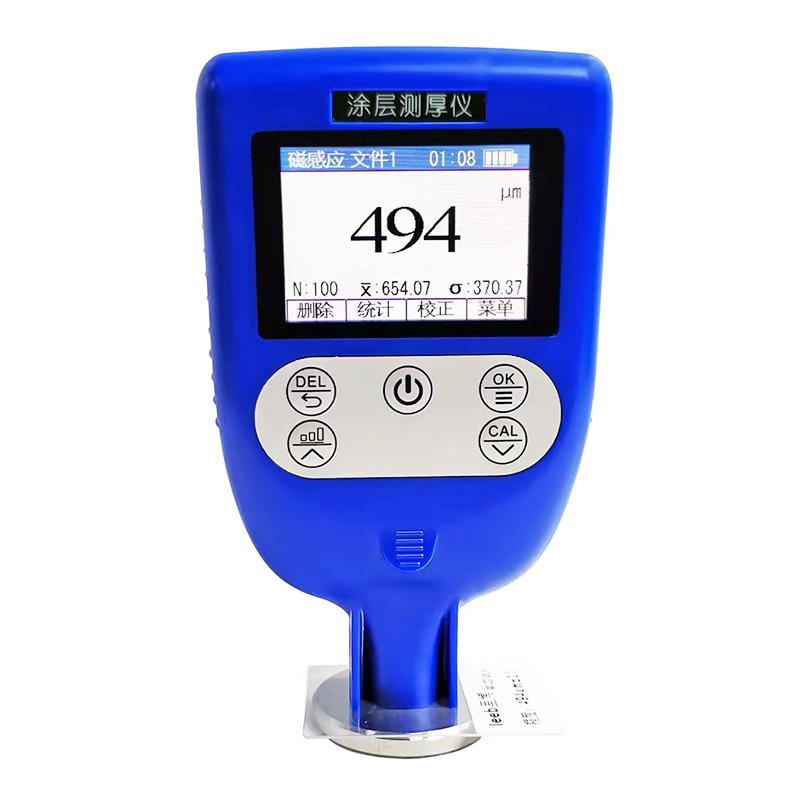
Overview
This instrument is a magnetic, eddy current integrated portable coating Thickness Gauge, which can quickly and non-damaging coating thickness measurement. It can be used both in the laboratory and in the engineering field. This instrument can be widely used in manufacturing, metal processing industry, chemical industry, commodity inspection and other testing fields, and is an important instrument for material protection.
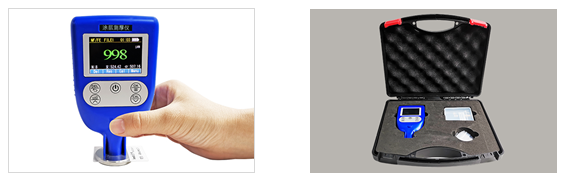
Meets standards
GB/T 4956-1985 Measurement of thickness of non-magnetic overlay on magnetic metal substrate -- Magnetic method
GB/T 4957-1985 Thickness measurement of non-conductive overlay on non-magnetic metal substrates -- Eddy current method
JB/T 8393-1996 Magnetic and eddy current cladding Thickness Gauge
JJG 889-95 Magnetoresistive Thickness Gauge
JJG 818-93
Features
Two thickness measurement methods, magnetic and eddy current, are used to measure the thickness of the non-magnetic overlay on the magnetic metal substrate and the thickness of the non-conductive overlay on the non-magnetic metal matrix.
There are two measurement methods: continuous measurement and single measurement
It has three measurement modes:The high-precision measurement mode can average multiple measurements and automatically filter the suspicious data to ensure that the measured values are more accurate and stable. The fast measurement mode enables real-time scanning capabilities.
It has a temperature compensation function:Real-time temperature compensation technology automatically compensates for measurement errors caused by changes in ambient temperature and probe temperature, making measurements more accurate.
There are five statistics:MEAN (MEAN), MAXIMUM (MAX), MINIMUM (MIN), NUMBER OF TESTS (NO.), STANDARD DEVIATION (S.DEV).
The instrument can be calibrated using zero, single- or two-point calibration, and systematic errors in the probe can be corrected using basic calibration and temperature coefficient calibration.
It has a storage function:Up to 500 measured values can be stored.
It has a delete function:Delete a single suspicious data that appears in a measurement, or delete all data in the store so that a new measurement can be made.
Limits can be set:Automatic alarms for measured values outside the limits.
It has the function of power level indication.
There is a beep prompt during operation.
It is said that there are three ways to shut down:Manual shutdown mode, timeout automatic shutdown mode and low-battery automatic shutdown mode, and the waiting time for timeout automatic shutdown can be set.
Description
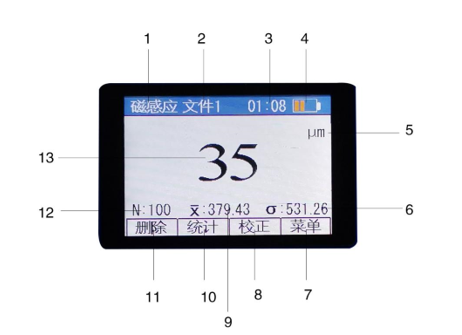
| 1. Measurement mode | 2. Currently stored documents | 3. Time display | 4. Battery level |
| 5. Unit of measurement | 6. Standard deviation of measured values | 7. Menu | 8. Correction |
| 9. The average value of the measured value | 10. Statistics | 11. Deletion of data | 12. The number of measurements |
| 13. Current measurement data |
Principle
This instrument adopts two thickness measurement methods, magnetic and eddy current, which can measure the thickness of the non-magnetic covering layer (such as aluminum, chromium, copper, enamel, rubber, paint, etc.) on the magnetic metal matrix (such as iron, cobalt, nickel) and the thickness of the non-conductive covering layer (such as enamel, rubber, paint, plastic, etc.) on the non-magnetic metal matrix (such as copper, aluminum, zinc, tin, etc.).
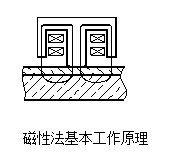
A. Magnetic method (F-type probe):
When the probe is in contact with the overlay, the probe and the magnetic metal substrate form a closed magnetic circuit, due to the presence of the non-magnetic overlay, the magnetic circuit reluctance changes, and the thickness of the overlay can be measured by the change of its magnetic resistance.
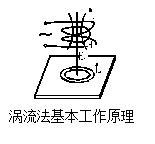
A. Eddy current method (N-type probe):
The high-frequency alternating current is used to generate an electromagnetic field in the coil, and when the probe is in contact with the overlay, eddy currents are generated on the metal substrate, and feedback is generated on the coils in the probe, and the thickness of the overlay can be derived by measuring the magnitude of the feedback action.
- 1Application, Principle Introduction and Precautions for Selection of Pipeline Thickness Gauges
- 2Principle and Application Analysis of Silver Plating Thickness Gauge
- 3Basic principle and application scenario of steel Coating Thickness Gauge
- 4Principle, Application and Selection of Coating Thickness Gauge for inner wall of small pipe
- 5Principle, application and selection of stainless steel paints Coating Thickness Gauge
- 6Principle, application and selection of traffic coatings Coating Thickness Gauge