
LANYU T200 Pro Digital Stirrer 100L/50~3000rpm
SE T200 Pro

LanYu T200 Pro Digital StirrerSPEC
LanYu T200 Pro Digital StirrerDetails
LanYu T200 Pro Digital StirrerPacking list
- SKU
- NB045686
- Rated Voltage
- AC 220V
- Rated Frequency
- 50/60Hz
- Input Power
- 500W
- output power
- 320W
- drive type
- DC brushless motor
- Output torque of stirring shaft
- 200N.cm
- Output peak torque of stirring shaft
- 320N.cm
- Allowable continuous running time
- 100%
- Rotation speed control
- Control knob
- Speed regulation mode
- stepless
- Speed range
- 50~3000rpm
- Timer Range
- 1~6000min
- Running status display
- TFT LCD screen
- Rotation speed dynamic detection function
- Yes
- Rotation speed memory function
- Yes
- Overload protection function
- Yes
- Temperature display
- Yes
- keylock function
- Yes
- Torque measurement
- trend
- Wireless Controller 200 meters
- optional module
- Temperature measurement
- optional module
- External temperature sensor interface
- PT1000
- Measurement range
- -50~400℃
- Measurement Accuracy
- 0.1K
- Stirringrod fixing method
- Quick turn chuck
- Rotary collet clamping range
- 3~13mm
- Hollow shaft (can be inserted in stop state)
- 12mm
- Impeller configuration
- Four Blade Spiral Impeller
- Processing Capacity
- 100L
- maximum viscosity
- 130000mpa.s
- Environmental temperature
- Less than 40 ℃
- Environmental humidity
- Not more than 80%
- Protection level
- IP40
- Dimensions of the whole machine
- 600x320x220mm
- Machine Weight
- 15Kg
Introduction
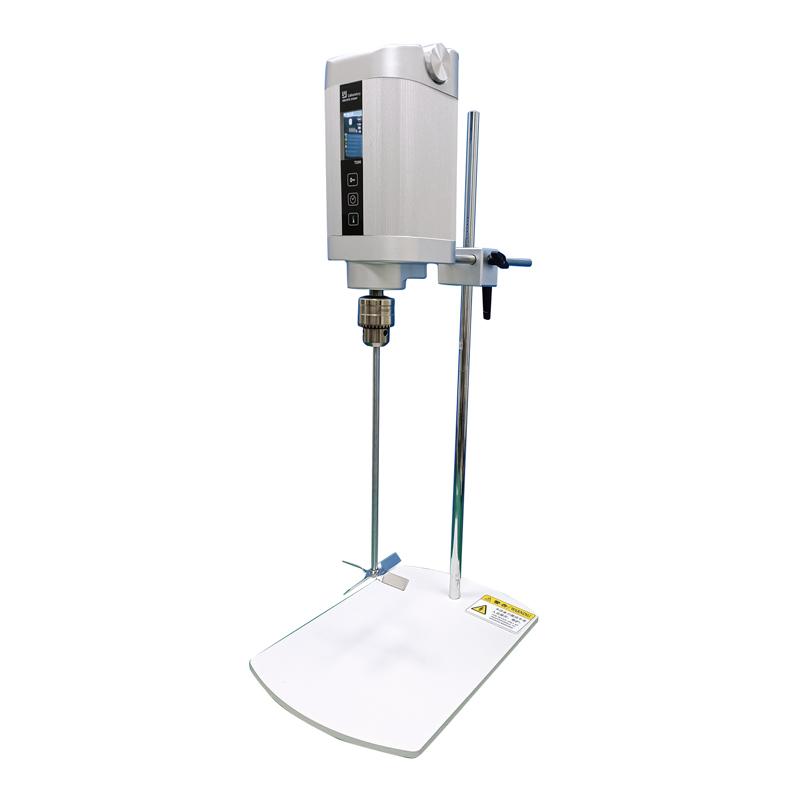
The T200 Pro+ intelligent CNC mixer is a device that realizes the mixing process through digital control technology and has precise control and adjustment functions.
CNC laboratory mixers are mainly used in laboratories to mix and stir liquids, solutions, suspended liquids, etc. This equipment is widely used in laboratory research and production processes in chemistry, biology, food science and other fields. In laboratory work in analytical chemistry, biology and other scientific fields, this mixer can be used for the preparation of standard solutions, stirring of culture media, etc. Some CNC laboratory mixers are also equipped with temperature control functions, which are suitable for experiments that require control of reaction temperature.
Characteristics
CNC laboratory mixers adopt digital control technology, and users can set precise parameters, such as mixing speed, time, temperature, etc., through the panel or software interface.
It has high-precision stirring speed and temperature control to ensure the accuracy and repeatability of experiments.
Some models are equipped with safety features such as overheating protection, overload protection, etc. to ensure the safe operation of the device.
Some CNC mixers have automation functions and can be programmed to perform the automatic mixing process to improve experimental efficiency.
Key points for selection
When choosing a CNC laboratory mixer, you need to select a mixer with appropriate capacity according to experimental needs to ensure that it can meet the mixing requirements of the sample. Different experiments require different mixing speeds, so it is more flexible to choose a mixer with a wide speed range and good adjustability. For experiments that require temperature control, choose a mixer with temperature control function. Pay attention to the safety performance of the equipment, such as whether it has overheating and overload protection functions.
CNC laboratory mixers improve the precision and automation of the mixing process through digital control and are suitable for laboratory applications that require a high degree of control and accuracy. Choosing the appropriate model should be based on the specific needs and application scenarios of the laboratory.
- 1GB/T 22459.6-2022《Refractory mortars—Part 6: Determination of moisture content of ready-mixed mortars》
- 2HG/T 20569-2013《Mechanical mixing equipment》
- 3GB/T 21868.3-2008《Pigments and extenders - Methods of dispersion for assessment of dispersion characteristics - Part 3: Dispersion using a high-speed impeller mill》