
DUBAN DB20-CM212 Statistical Coating Thickness Gauge integrated probe 0~1250µm
SE DB20-CM212

Duban DB20-CM212 Coating Thickness GaugeSPEC
Duban DB20-CM212 Coating Thickness GaugeDetails
Duban DB20-CM212 Coating Thickness GaugePacking list

- SKU
- NB047448
- Standard test scope
- 0~1250µm/0~50mil (Miscellaneous Measurement range can be customized)
- resolution
- 0.1 µm (below 100 µm); 1 µm (above 100 µm); 0.1 mil
- Measurement Accuracy
- +/- 1 to 3% n or +/- 2.5 µm or 0.1 mil
- Thinnest substrate
- 0.3mm / 12mil
- Minimum convex diameter
- 26mm / 1.02inch
- Minimum concave radius
- 50mm / 1.97inch
- Minimum measurement surface diameter
- 26mm / 1.02inch
- Measurement mode
- Single measurement and continuous measurement
- operating conditions
- Temperature: 0~50 ℃ (32~ 122 ° F); Humidity: < 80% RH
- Power Supply
- 2X1.5vAAA 7 #battery
- size
- 129x68x27mm
- Weight
- 90G (without battery)
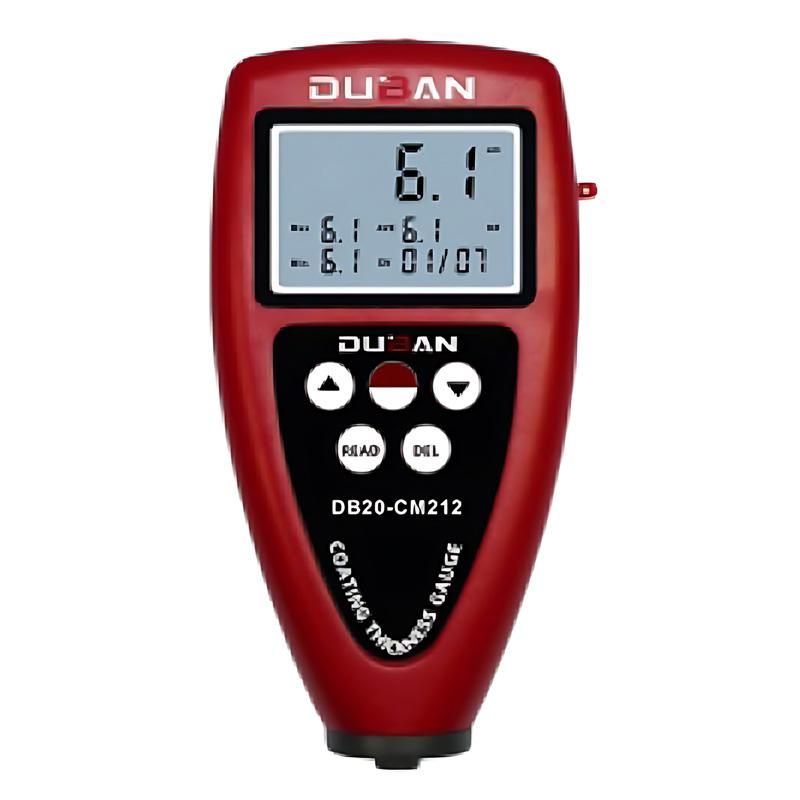
The DB20-CM212 is an all-in-one typeStatistical coating Thickness GaugeIt can store 99 sets of new measurement data values, which has the characteristics of small measurement error, high reliability, good stability and easy operation, and is an indispensable non-destructive testing instrument for controlling and ensuring product quality. It is a portable battery-powered measuring instrument using the principles of magnetic induction and eddy current. The measurement method conforms to the international standards ISO2178, ISO2360 and national standards GB4956, GB4957. It uses a number of advanced technologies such as computer technology and non-destructive testing technology to accurately measure its thickness without damaging the measured body.
F-type probe
The thickness of the non-magnetic overlay (e.g., paint, plastic, enamel, copper, aluminum, zinc, chromium, etc.) on the surface of magnetically permeable materials (e.g., iron, nickel) can be directly measured. It can be applied to the thickness of electroplating, paint layer, enamel layer, aluminum tile, copper tile, babbitt tile, phosphating layer, and paper
It can also be used for thickness measurement of hull paint and adhesions of underwater structural parts.
NF type probe
It can measure the thickness of the insulating covering layer on non-magnetic metal substrates, such as paint, plastic, rubber coatings on the surface of materials such as aluminum, copper, zinc, non-magnetic stainless steel, etc., and can also measure the anodizing thickness of aluminum or aluminum alloy materials.
Features
Spring-loaded guided-sleeve probes with wear-resistant hard metal probes can measure on hard or rough surfaces with constant compression force and stable sampling values.
Wide measuring range and high resolution.
Automatic memory of calibration values for ease of use.
Integrated structure, small size and light weight.
Digital backlit display with no parallax.
It can store 99 sets of data; By measuring the average, the most
The large and minimum values implement the statistical function of the instrument.
With optional USB software and cables, it can communicate with a PC computer to realize data acquisition, processing, analysis, and printing functions.
It is equipped with automatic shutdown to achieve power saving function.