
HUITAO HT-108 reciprocating Wear resistance testing apparatus Coating Wear resistance Tester Double station
SE HT-108

huitao HT-108 Reciprocating Wear resistance testing apparatusSPEC
huitao HT-108 Reciprocating Wear resistance testing apparatusDetails
huitao HT-108 Reciprocating Wear resistance testing apparatusPacking list
- SKU
- NB048293
- Friction method
- reciprocating
- Frictional contact form
- line
- Test Travel
- 6-150Mm adjustable
- Power Supply
- 220V,50HZ,3A
- Machine size
- 532*471*630mm
- Machine Weight
- 48.5kg
- speed range
- 1-100 reciprocating/min stepless adjustable
- Display
- LCD screen control, can set parameters such as speed and number of reciprocating movements
- station number
- Two-station design saves test time
Introduction
The reciprocating abrasion Tester is used to test the scratch and abrasion resistance of coatings, plastics, decorative fabrics, automotive interiors, velvet fabrics, etc. The LCD screen controls and displays the test process, and can set parameters such as reciprocating wear times, movement stroke, and reciprocating movement speed according to user needs. * The friction arm design realizes the replacement of different friction heads. The implementation of pressure is controlled according to the principle of lever balancing. It fully meets the different requirements of different standards for friction form, friction head, pressure, etc. Fabric reciprocating abrasion Tester is an instrument for measuring the "abrasion resistance" of fabrics. It is a kind of fabric flat Grinder. It is mainly composed of motion platforms, brackets, etc. Linear reciprocating motion is generated by electric motor transmission. The fabric specimen is mounted at a certain tension on the motion platform. Place the bracket wrapped with an abrasive (e.g., No. 400 water sandpaper) onto the specimen and rub back and forth. Or wrap the specimen around the bracket and flatten the abrasive tension on the motion platform. The bracket and the motion platform move relatively, and the specimen is subjected to reciprocating wear on the plane. Measure the change or damage of the weight, light transmittance and intensity of the sample under a certain number of times to determine the wear resistance of the sample.
Test principle
The test specimen is fixed on a horizontal stage and is worn down with the horizontal movement of the stage under a defined abrasive and load. The other end of the test arm is equipped with a weight to keep the test arm balanced to ensure that the load on the surface of the sample is accurate. The abrasive and load racks are height-adjustable to suit the testing of samples of different heights.
Test Standards
ASTM F2496、ISO 1518-1、ISO 1518-2、GME 60248、D42 1775、
MS652-15、DBL 7384-2017 8.10 PV3987
ASTM F2495 Test for Determining Energy Consumption of Multifunctional Devices with Reproducibility and Similar Office Imaging DevicesTest method
GME 60248 Test for Scratch Resistance of Elastomers and Textile Coatings for Interiors
GME 60368 Linear Tribological Testing
GMW 14125 Linear Tribological Test
MS655-08 Linear Friction and Scratch Resistance Test
MS652-15 Linear Friction and Scratch Resistance
Volkswagen PV3906
ISO 1518 Pigments and varnishes Determination of scratch resistance
ISO 105 X12 Textiles - Colour fastness test – Part X12: Colour fastness to rubbing
ISO 105 D02 Textiles. Colour fastness test. Part D02: Colour fastness to rubbing. Organic solvent method
ASTM F1319 Standard Test Method for Abrasion and Stain Resistance of Printed Matter (Tribometer Method)
GB/T 9279 Stain paint and varnish scratch resistance test, etc
Instrument structure
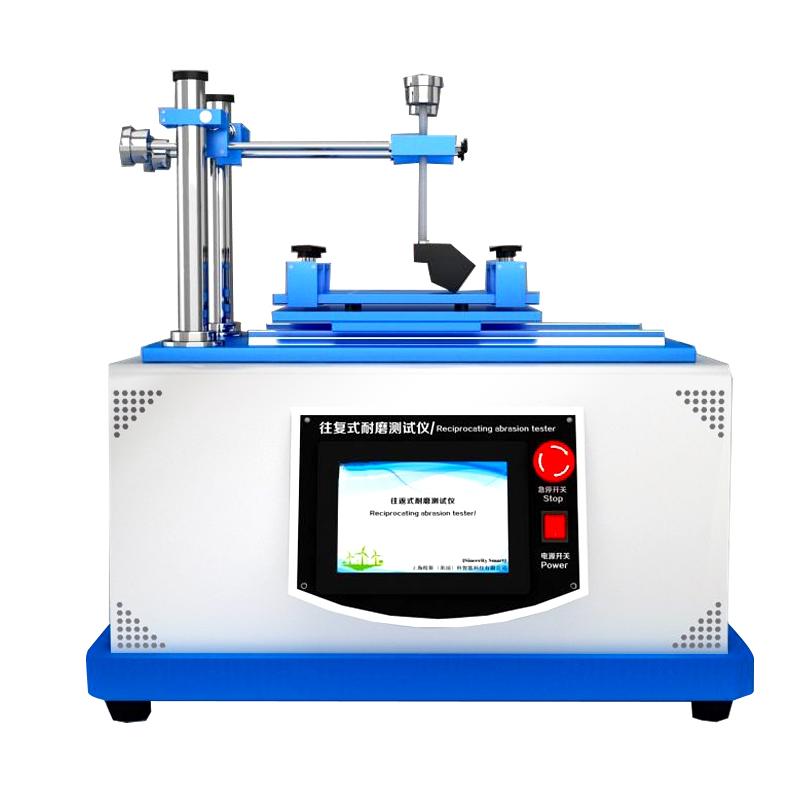
The instrument consists of the following parts: additional weights, friction heads, balance rods, fixing knobs, locking knobs, balance weights; LCD screen; power switch; E-STOP button.
1. Additional weights: According to the standards and customer needs, different additional weights are equipped, and after adjusting the balance, the weight of the additional weights is the weight pressed on the sample.
2. Friction head: According to different standards and customer needs, there are a variety of friction heads that can be replaced. The instrument is equipped with a friction head and its clamp as follows: for the D42 1775 grinding head, sandpaper needs to be attached to the arc surface of the grinding head during use. For the rubber grinding head and the sleeve, the sleeve needs to be disassembled in use, the green grinding head is put into the middle of the sleeve, and then the top wire is highlighted and tightened, and the grinding head exposes the surface of the sleeve 0.1in.
3. Fixed knob: Loosen the fixed knob, if the weight of the balance weight and the weight of the friction head cannot reach the balance, the balance bar will be tilted. Conversely, if the fixing knob is locked, the current position can be locked even if the equalizer bar is unbalanced.
4. Locking knob: After tightening, the front and rear proportions of the balance bar can be locked.
5. Balance bar: It plays the role of measuring whether the lever balance is achieved and the role of supporting the connection.
6. Balance weight: According to the principle of lever balance, move the front and rear positions of the balance weight and balance it with the friction head. The pressure of the additional weight is the pressure on the actual fabric.
7. LCD screen: it has the function of setting test parameters, displaying and controlling the test process.
8. Power switch: start or turn off the instrument.
9. Emergency stop button: In case of emergency, press the emergency stop button and the instrument will be shut down.