
LINSHANG LS255 Webster Hardness Tester
 LS255
LS255

LinShang LS255 Wechsler Hardness TesterSPEC
LinShang LS255 Wechsler Hardness TesterDetails
LinShang LS255 Wechsler Hardness TesterPacking list
- SKU
- NB049420
- Hardness
- HWA、HRE、HRF、HRB、HV、HB
- Measurement Range
- HWA(0-20); HRE(23.5-110); HRF(26.2-105.5); HRB(0-85.3); HV(49-155); HB(35.2-153)
- resolution
- 0.1HWA
- measurement Accuracy
- ±0.5HWA
- Sexual repeability
- 0.5HWA
- Film thickness of material under test
- 0.6mm-8mm
- inner diameter of material under test
- >10mm
- Display
- 128 * 64 point array OLED
- Power Supply
- Rechargeable lithium battery 3.7V@400mAh, single charge can be continuously measured more than 5000 times
- Charging port
- USB(Type-C)
- size
- 203*97*30 mm
- Weight
- 484g
- operation temperature range
- -10~50 ℃, 0~85% RH (no condensation)
- Storage temperature range
- -10~60 ℃, 0~85% RH (no condensation)
- supply Voltage
- DC5V
- Operating Current
- 10mA
- operating power consumption
- 50mW
Introduction
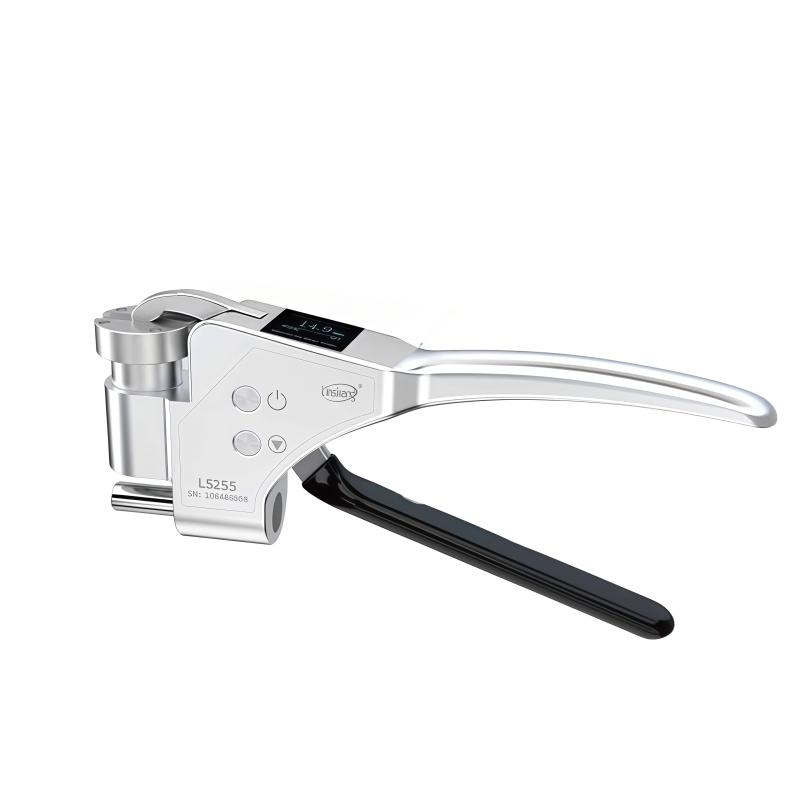
Webster Hardness Tester detects hardness according to Webster Hardness measurement principle, and is suitable for hardness measurement of metal materials such as aluminum alloy, brass, copper, and mild steel. The instrument adopts the principle measurement technology of vortex flu, which has good repeatability and measurement accuracy. Built-in a variety of hardness systems, can be converted between Wechsler (HWA), Rockwell (HRE), Rockwell (HRF), Rockwell (HRB), Vickers (HV), Brinell (HB) and vice versa.
Meets standards
GB/T 32660.1-2016 Metallic materials -- Webster Hardness test – Part 1: Test methods
GB/T 32660.2-2016 Metallic materials -- Webster Hardness test -- Part 2: Calibration and calibration of Hardness Testers
GB T 32660.3-2016 Metallic materials -- Webster Hardness test – Part 3: Calibration of standard hardness blocks
GB/T 33362-2016 Conversion of hardness values for metallic materials
JJG 944-2013 V. R. of Webster Hardness Tester of Metal
Features
The instrument adopts the principle measurement technology of vortex flu, which has good repeatability and measurement accuracy.
The digital display Webster Hardness Tester has an OLED screen at the top of the instrument, which makes the measurement results easy and convenient to read.
All-in-one design, compact size, easy to carry.
A variety of hardness standards are automatically switched, eliminating the cumbersome manual checking.
User-calibrated and errors can be eliminated by calibrating the master parts.
The ultra-low power consumption design of the instrument can continuously measure more than 5000 times in a single full charge.