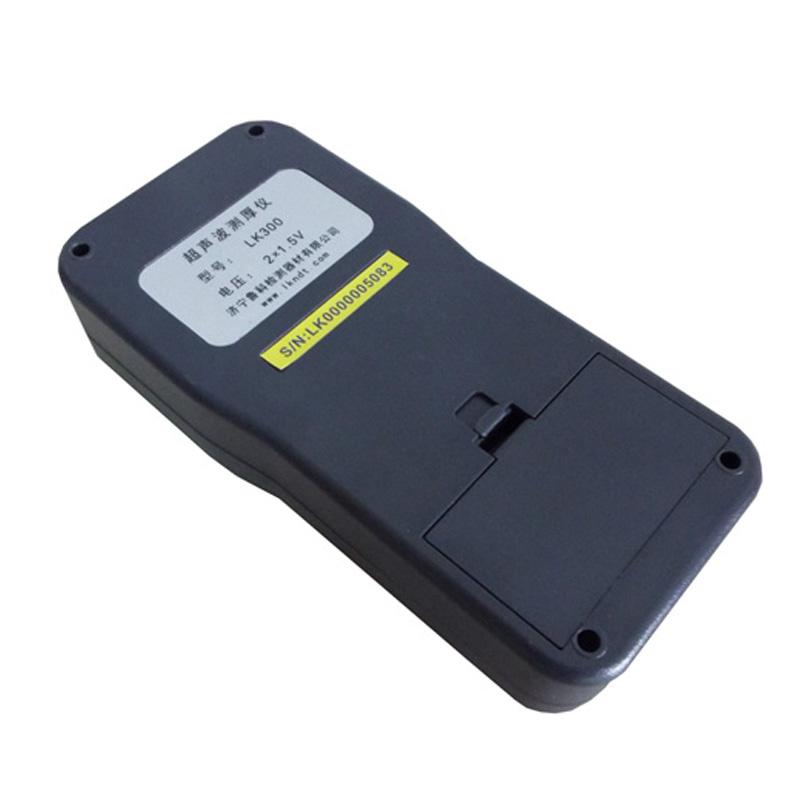
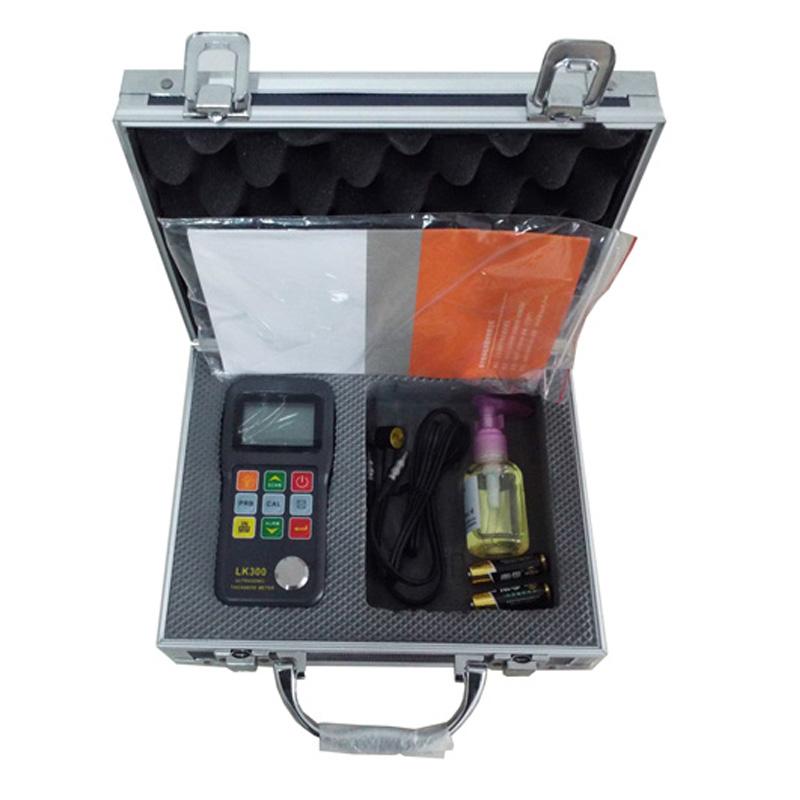

LUKE LK300 Ultrasonic Thickness Gauge Measurement range 0.75~ 300mm
 LK300
LK300

LUKE LK300 Ultrasonic Thickness GaugeSPEC
LUKE LK300 Ultrasonic Thickness GaugeDetails
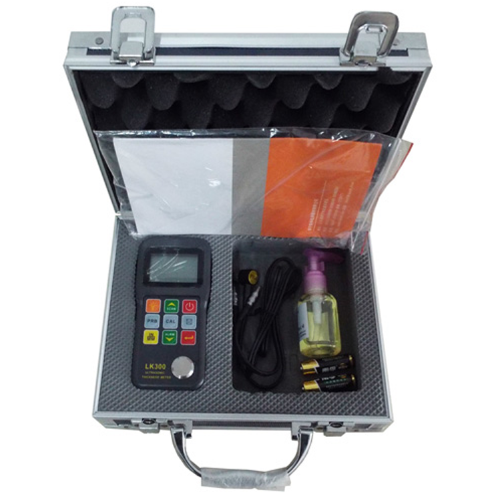
LUKE LK300 Ultrasonic Thickness GaugePacking list
- SKU
- NB007631
- Measurement range
- 0.63~ 500Mm (steel, depending on probe)
- Probe Frequency
- 1MHz~10MHz
- Calibration method
- Dialog Probe, Automatic calibration
- Speed of sound
- 1250~10000m/s
- Display
- LCD display with backlight
- Power Supply
- 2 AA batteries. The continuous use time is up to 200 hours. When the battery power is insufficient, the display will flash an alarm until it automatically shuts down.
- Display Accuracy
- 0.01mm
- scanning method
- 16 points per second measurement, can capture the thinnest point
overview
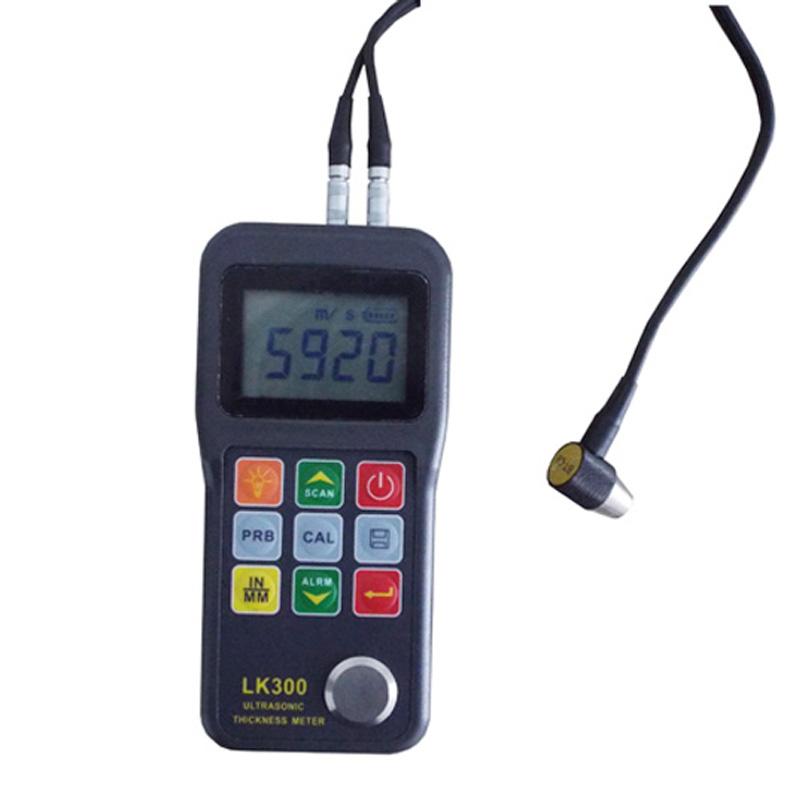
Luke LK300 ultrasonic Thickness Gauge is an intelligent ultrasonic Thickness Gauge based on the principle of ultrasonic measurement, using new high-performance, low-power microprocessor technology, which can measure the thickness of metals and other materials, and can measure the ultrasonic sound velocity of materials. In addition, the instrument can monitor various pipes and pressure vessels in production equipment, monitor their degree of thinning after corrosion during use, and can also accurately measure various plates and various machined parts. This instrument can be widely used in petroleum, chemical industry, metallurgy, shipbuilding, aviation, aerospace and other fields.
Features
1. It is suitable for measuring the thickness of metals (such as steel, cast iron, aluminum, copper, etc.), plastics, ceramics, glass, glass fibers and any other good conductors of ultrasonic;
2、It can be equipped with a variety of dual element probes with different frequencies and different element sizes;
3、It has the functions of zero point calibration and two-point calibration of the probe, which can automatically correct the system error;
4、Known thickness can be used to measure the sound velocity back, so as to improve the measurement accuracy;
5、It has the function of coupling status prompt;
6、There is EL backlight display, which is convenient to use in dimly lit environments;
7、There is a residual power indication function, which can display the remaining battery power in real time;
8、It has power-saving functions such as automatic sleep and automatic shutdown;
9、With RS232 interface, it can easily and quickly exchange data with the PC, and can be connected to the micro printer (manufacturer-specified model) to print the measurement report;
10、It can be equipped with microcomputer software, which has rich functions such as transmitting measurement results, measuring value storage management, measuring statistical analysis, printing measurement report, etc.;
11、Small, portable, high reliability, suitable for harsh operating environments, resistant to vibration, shock and electromagnetic interference;
Instrument configuration and probe selection
Table 1.1 Instrument configuration
serial number | name | quantity | remark | |
Standard configuration | 1 | host | 1 unit | |
2 | Standard Probe (BT-08) | 1 pc | ||
3 | Couplant | 1 bottle | ||
4 | Instrument case | 1 pc | ||
5 | Instruction manual | 1 serving | ||
6 | AA (size 5) alkaline batteries | 2 pcs | ||
Optional | 7 | Coarse Grain Probe(ZT-12) | ||
8 | Small Diameter Tube Probe (XT-06) | |||
9 | High Temperature Probe (GT-350) | |||
10 | Micro printers | 1 unit | Applied on the computer | |
11 | Print the cable | 1 article | ||
12 | Data management software | 1 set | ||
13 | Communication cables | 1 article |
Table 1.2 Probe Selection
name | Model | Frequency (MHZ) | Probes Straight diameter | Measuring range | Minimum pipe diameter | Description |
Coarse-grain probes | ZT-12 | 2 | 12mm | 3.0mm~300.0mm(Steel) | Φ20mm | It is used for measuring coarse-grained materials such as cast iron |
Standard probes | BT-08 | 5 | 8mm | 1.0mm~230.0mm(Steel) | Φ20mm×3.0mm | general |
Small-diameter tube probes | XT-06 | 7.5 | 6mm | 0.75mm~80.0mm(Steel) | Φ15mm×2.0mm | It is used for the measurement of thin-walled and small-cambered pipes |
High temperature probes | GT-350 | 5 | 14mm | 3~200mm(Steel) | Φ30mm | It is used for the measurement of materials with temperatures less than 350°C |
- 1Film Thickness Gauges for steel applications
- 2Ultrasonic Thickness Gauge measurement why must use coupling agent?
- 1ASTM E797-2021《Standard Practice for Measuring Thickness by Manual Ultrasonic Pulse-Echo Contact Method》
- 2GB/T 11344-2008《Non-destructive testing - Practice for measuring thickness by ultrasonic pulse-echo contact method》
- 3JJF 1126-2004《Ultrasonic Thickness Gauge calibrating specification》
- 4ZB N 77001-1989《General Technical Conditions for Ultrasonic Thickness Gauge》