How to determine the bending resistance of anti-corrosion pipe coating?
According to a standard SY/T0315-97 in the oil and gas industry, the bending resistance of anti-corrosion pipeline coatings is determined as follows.
(1) Equipment required for the test
① Pressure testing machine.
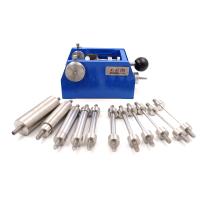
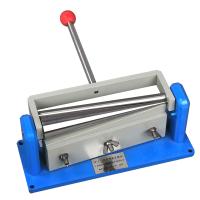
② Bending mandrel.
③ freezer.
(2) Test piece
The size of the laboratory coating test piece is about 200mmX25mmX6mm, and the size of the pipe section test piece is about 200mmx25mmxpipe wall thickness, of which 200mm is the axial size of the pipe section, and the number of test pieces is 3 pieces.
(3) Test procedure
① Coating edges should be smooth to eliminate any potential stress risers. Put the 1 piece into the freezer, cool to -3o ℃ ± 3 ℃, and keep it for at least 1h.
②Put the test piece on a plane, measure the thickness of the test piece (t), this value is the sum of the wall thickness of the steel pipe of the test piece and the inner arc chord height.
③Use the formula (6-19) to obtain the radius of the core ratio, and the mandrel corresponds to a 3° angle of bending of the unit pipe diameter length:

④Use the formula (6-20) to obtain the radius of the core ratio, the core and the axis correspond to the unit pipe diameter length bending angle of 2.5°:

In the formula:
R2-required mandrel radius, mm;
t-thickness of specimen, mm.
⑤ Put the test piece on the mandrel with the selected radius of curvature for bending test. The bending process of each test piece should be completed within 30s after being taken out of the freezer, and the bending rate should be kept within 10s for the whole process .
⑥Heat the above test piece to 20℃±5℃ and maintain this temperature for at least 2h. Within 1h thereafter, visually test whether there are cracks in the piece.
- 1Analysis of Surface Defects of Explosion Holes and Fisheye-Anticorrosive Coatings
- 2What is an anti-corrosion coating?
- 3Failure of anti-corrosion coatings
高瑾 米琪 - 《《防腐蚀涂料与涂装》》
- 4Double top coating: how it works, how to apply it
Shivananda Prabhu
- 5Preparation method of polyaniline anti-corrosion coating
- 6Advantages and Disadvantages of Cross Cutting Method, Drawing and Adhesion Method
- 7Introduction to anti-corrosion mechanism of coating
- 8Construction method of heavy anti-corrosion painting brushing
- 9The role, performance and characteristics of anti-corrosion coating