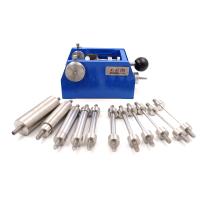
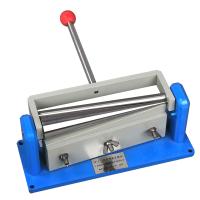
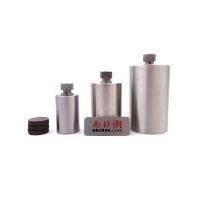
Advantages and Disadvantages of Cross Cutting Method, Drawing and Adhesion Method
Whether it's a massive structure or the smallest household instrument, many products are coated for protection and beautification. The replacement or repair work caused by the premature peeling off of the coating will inevitably lead to an increase in cost.
Adhesion testing after the painting process will provide a quantitative indication of the bond strength between substrate and coating, and between coatings. Adhesion testing is a required part of the inspection and repair process to detect potential coating damage.
Most coating inspection instrument manufacturers offer adhesion Measurement Instruments for a wide range of applications, which fall into three categories:
Cross-cut method cuts the coating into small cubes to reduce side bonding, evaluated according to ISO, ASTM or company standards
Pull Attachment Method A circular dolly is glued to the coated surface and after the adhesive has dried, the force required to pull the circular dolly away from the coated surface is measured.
Push Attach Method Similar to the pull attachment method, a circular dolly is glued to the coated surface, and after the adhesive has dried, the force required to push the circular dolly out of the coated surface is measured.
How to choose the right adhesion Tester:
Cross cut method :
Pros: Fast, low cost, comparative methods - see table below.
Possible limitations: Applicable to a certain thickness range, flat coating measurement
Scope of application: Paint and powder coating thickness up to 125μm (5mils).
Pull Attachment Method
Advantages: Simple to use, quantitative measurement - gives a definite adhesion value.
Possible limitations: Time required for adhesive to dry.
Scope of application: laboratory or outdoor use - flat or curved surface.
Advancing Attachment Method
Pros: Adhesive dries quickly, ideal tool for measuring curved surfaces.
Possible limitations: Excessive force with which the instrument pushes out the round forging film can damage thinner substrate surfaces.
Applications: Spray coating of pipes and metals.
Take Elcometer as an example:
Current location: Home> Article reading> Encyclopedias> Several conventional adhesion testing methods
Several Conventional Adhesion Testing Methods
Suggested by: Source: Time: 2016-09-20 11:55 Reading: 5 times big, medium and small
Whether it's a massive structure or the smallest household instrument, many products are coated for protection and beautification. The replacement or repair work caused by the premature peeling off of the coating will inevitably lead to an increase in cost.
Adhesion testing after the painting process will provide a quantitative indication of the bond strength between substrate and coating, and between coatings. Adhesion testing is a required part of the inspection and repair process to detect potential coating damage.
Elcometer offers a wide range of adhesion measuring instruments for a wide range of applications, these instruments are divided into three categories:
Cross-cut method cuts the coating into small cubes to reduce side bonding, evaluated according to ISO, ASTM or company standards
Pull Attachment Method A circular dolly is glued to the coated surface, and after the adhesive has dried, the force required to pull the circular dolly away from the coated surface is measured.
The push attachment method is similar to the pull attachment method in that a circular dolly is glued to the coated surface and, after the adhesive has dried, the force required to push the circular dolly out of the coated surface is measured.
See product details.
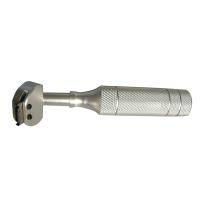
Elcometer 1540 Cross Cut Measuring Instrument (Big Knife)
This is a simple instrument for quickly measuring the adhesion of many different kinds of coatings.
Made of stainless steel, 11 tapered teeth with a pitch of 1mm.
Elcometer 1542 Cross Cut Adhesion Gauge
It is a simple and effective method of adhesion measurement for many different types of coatings and is suitable for testing thin coatings on flat surfaces. According to the thickness of the coating to be tested, there are three kinds of cutter teeth with different pitches for selection.
Elcometer 107 Cross Cutter
The Elcometer 107 Cross Cutter provides an instant assessment of the quality of the connection to the substrate. Due to its robust construction, the instrument is suitable for the measurement of various thicknesses or rough coatings on flat or curved surfaces. It can be used for outdoor and laboratory measurement.
Elcometer 108 Hydraulic Adhesion Tester
The Elcometer 108 is a very versatile hydraulic adhesion Tester which can meet many practical adhesion testing requirements. Can measure flat, curved surfaces (concave and convex).
A reusable circular dolly is attached to the coated surface and the circular dolly is pulled away from the coated surface with the handle. Pull-off force is displayed numerically or on an analog dial. When in explosive areas, it is necessary to select the analog dial.
Elcometer 106 Pull-off Adhesion Tester
Elcometer 106 Pull-off Adhesion Tester - Easy to use, portable and has a wide range of measurements. Applications include: inspection of bridge deck coatings or shotcrete, coatings on stainless steel, aluminum or concrete.
Elcometer 106/6 Concrete Coating Adhesion Tester
The Elcometer 106/6 Concrete Coating Adhesion Tester is specially designed for coatings on concrete.
Similar to the Elcometer 106 Coating Adhesion Tester, the Elcometer 106/6 is used on concrete coatings with a circular dolly diameter of 50mm (2").
Elcometer 109 Tensile Adhesion Tester
The Elcometer 109 Adhesion Meter is based on the specification parameters of the coating, and provides users with a simple means of adhesion testing, so as to judge whether the adhesion of the coating meets the requirements of the specification parameters.
Elcometer 110 Air Pressure Adhesion Tester
The Elcometer 110 is a portable air pressure adhesion Tester that uses compressed air from canned air.
Since the force used is controllable, the test results are highly reproducible. Provide users with satisfactory testing tools.
Elcometer 1910PAThandy™ Adhesion Tester
This hydraulic adhesion Tester is light in weight and easy to carry. In order to obtain stable accuracy, a hydraulic safety device is installed.
The unique test head design can be used for the measurement of the inner and outer layers of curved surfaces, suitable for the measurement of pipelines and protective coatings.
Elcometer 1940PAT™ GM01 Adhesion Gauge 6.3kN
This manual hydraulic tensile gauge, the most widely used ElcometerPATTM gauge, is suitable for measuring the adhesion of various paints, thermal spray coatings, films, concrete coatings, ceramic coatings, etc.
Elcometer 1941PAT™ GM01 Adhesion Gauge - 20 and 40kN
20kN or 40kN manual hydraulic tensile Tester to measure the adhesion of coatings (including thermal sprayed coatings) on test panels and sprayed workpieces.
Measure the adhesion of tile adhesives and other sticky materials with square test elements 50mm (2″) and 50x50mm (2x2″) in diameter.
Elcometer1970PFCV--Portable Field Calibration Verification Device
This portable site calibration and verification device is a satisfactory tool for confirming the calibration of the adhesion measuring instrument used, and can be used for adhesion measuring instruments such as ElcometerPATTM, Elcometer106, and Elcometer108.
- 1How to measure the Adhesion of anticorrosive pipe coating?
- 2How to measure the shock resistance of anti-corrosion pipe coating?
- 3How to determine the bending resistance of anti-corrosion pipe coating?
- 4How to test the porosity of anticorrosive pipe coatings?
- 5Coating and coating inspection standards
- 6Quantitative detection of coating bonding force--shear test method
- 7Determination of coating bonding strength - heating and cooling test method (thermal shock test)
- 8What is the binding force of the coat?
- 9Coating surface defect inspection