Concrete Coating Adhesion Tensile Strength Test (ASTM D4541)
Adhesion peel strength testing is used to determine the overall quality of a coating system, assessing the integrity of the installed system and its potential performance.
Adhesion testing is an important part of developing a concrete coating system, although it is only one of many reasons a coating may fail prematurely. Coating systems typically consist of a base coat or base coat, a build or chip coat and a top coat. Concrete floor coatings are supplied as systems to ensure a quality consistent with manufacturer's published data. Adhesion pull-off strength testing is important in determining the overall quality and integrity of an installed system and its potential performance, or lack thereof.
Concrete is known to have high compressive strengths, typically in the range of 2500-4000 psi, and often exhibits low tensile strengths of around 400-500 psi. Therefore, it is not surprising that adhesion breaking strength testing of most concrete coatings shows substrate failure in the 400-500 psi range. Most coatings fall into this category, where adhesion-pull strength testing shows the substrate to fail before the coating is applied.
Mixing and matching different coating materials without supporting test data is not recommended. The order in which materials are applied does matter! Cutting corners to save money will eventually lead to contractors installing inferior products, leading to callbacks for repair or replacement work.
Study on Adhesion of Acrylic Primer Coating System
A paint contractor explained that they had been installing a water-based acrylic sealer as a primer, followed by a water-based epoxy and polyaspartic topcoat, at the suggestion of another manufacturer in the floor coating industry. of. The contractor expressed interest in the system due to the lower material cost of the acrylic sealer/primer and the quick dry time between the primer and the water-based epoxy sheet. The answer to his question took some time for the required tests:
experimental design
The Coating Adhesion Peel Strength Test was designed to evaluate the contractor's inquired experimental coating system against Slide-Lok's standard floor coating system. Each coating system uses the same substrate, grinds the substrate to a similar profile, and applies the coating at the same time. This limits differences in temperature, humidity, substrate and applicator. To limit the adhesion pull area to just below the dolly, lightly scratch/cut the coating material around the dolly.
Focusing directly on the strength of the primer, sure lightly cutting/scoring around the dolly to remove excess 3M adhesive used to bond the dolly to the substrate will yield more accurate data. Although the ASTM D4541 standard states that "Notches around the fixture violate the basic test criteria for testing unchanged coatings. If notches are used around the test surface, extra care needs to be taken to prevent microcracks in the coating, which could lead to failure in the When the intensity is reduced. Scored samples constitute different tests, the procedure should be reported together with the results". The scoring/cutting around the dolly improves the standard and makes it a more accurate test, negating the elasticity and tensile strength of the excess 3M adhesive used to bond the dolly to the coating.
Adhesion Peel Strength Results
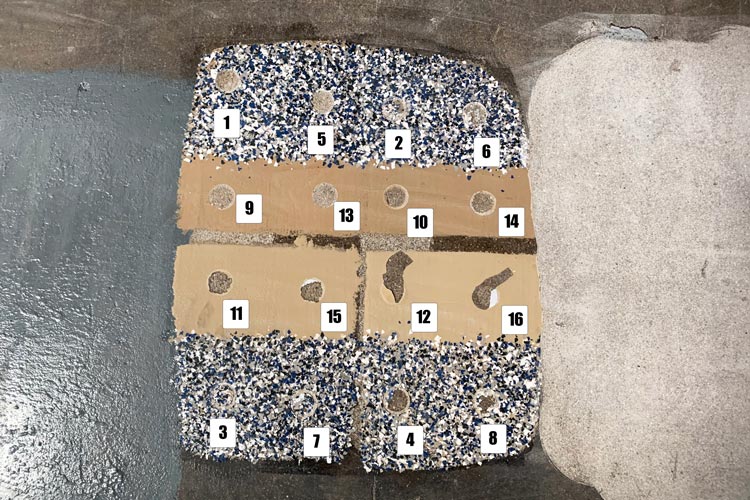
Looking at the results from the surface of the car and the location of the tow, you can start to see that not all coating systems are created equally. The surface of the cart and the location of the pull tell the unique story of each stick pull. It is important to evaluate each individual pull to determine whether the point of failure is on the substrate, within the coating itself, or at the glue/car interface. Recording this information and comparing it to the breaking strength stress can give a good idea of the overall quality of the coating system.
Control Cart - 513 psi
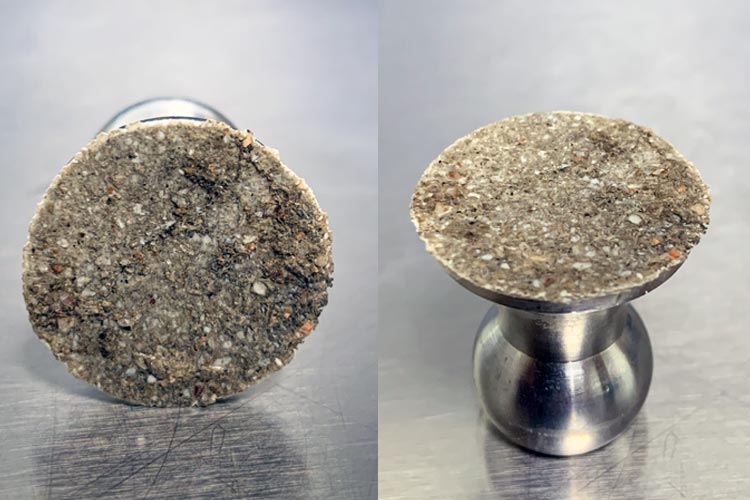
Any good study needs controls. The 20mm dolly was applied near the coating test square. The bonded tensile strength of the dolly bonded directly to the concrete substrate should be a good representative of the tensile strength of the concrete being tested. This particular little car takes off at 513 psi. Note that the surface of the dolly is not perfectly smooth, the concrete is poured, and there is uneven debris on the surface of the dolly, consistent with a substrate failure. With proper range control, you can compare this to the peel strength of the coating system in this study.
Waterborne Acrylic Sealer/Primer - 321 psi (primer fails)
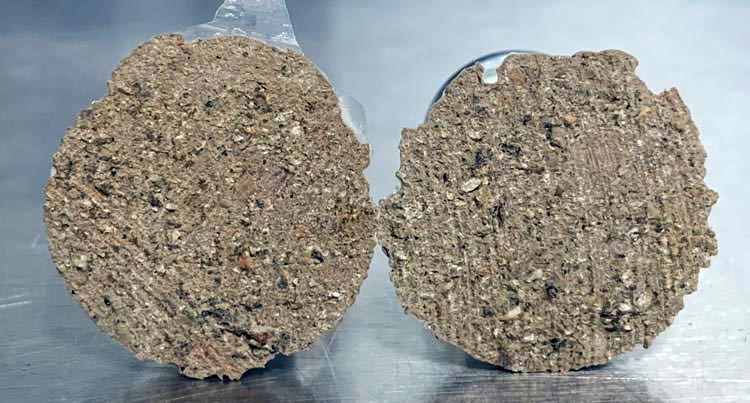
The first coating system, the upper left quadrant of the test square, consisted of a waterborne acrylic sealer/primer, a waterborne epoxy paint/chip coat, and a polyaspartic topcoat. The average adhesive peel strength of the acrylic primer system was 321 psi. Approximately 19.75%-35.8% lower than the typical tensile strength of concrete (400-500 psi), or 37.42% lower than a console car (513 psi). The surface of the trolley appears to have minimal concrete and is very smooth, the pull location shows no residual coating and no concrete pits indicating that the concrete has not cracked or moved with the trolley. This would be considered a failure of the bond between the primer and the substrate. The peel strength of acrylic primer systems is well below the typical tensile strength of concrete substrates. Acrylic sealer/primer system failed"
Waterborne Epoxy Primer - 881 psi (substrate failure)
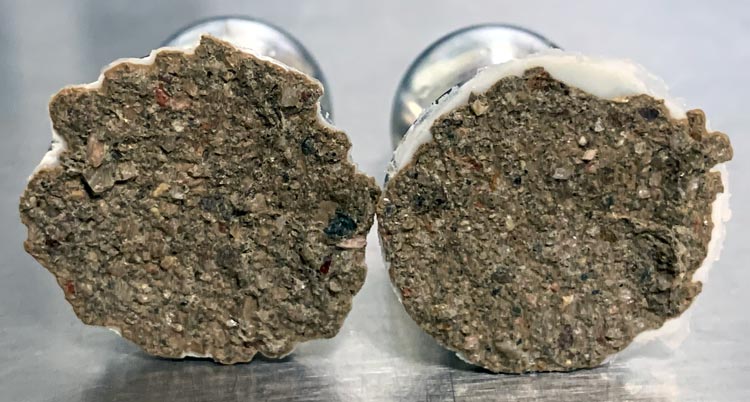
The second coating system, the upper right quadrant of the test square, consisted of a waterborne epoxy primer, a waterborne epoxy pigment/chip coat, and a polyaspartic topcoat. The average adhesion peel strength of the waterborne epoxy primer system was 881 psi. This is an excellent pullout value, approximately 176-220% higher than the typical tensile strength of concrete (400-500 psi), or 171.7% higher than a console car (513 psi). There are large pieces of concrete on the surface of the trolley, which is very rough and uneven, and there is no residual coating at the pulling position. This would be considered a substrate failure. The peel strength of this coating far exceeds the tensile strength of concrete, and the result of the coating penetrating the substrate actually strengthens it.
Epoxy 100 Primer - 925 psi (substrate failure)
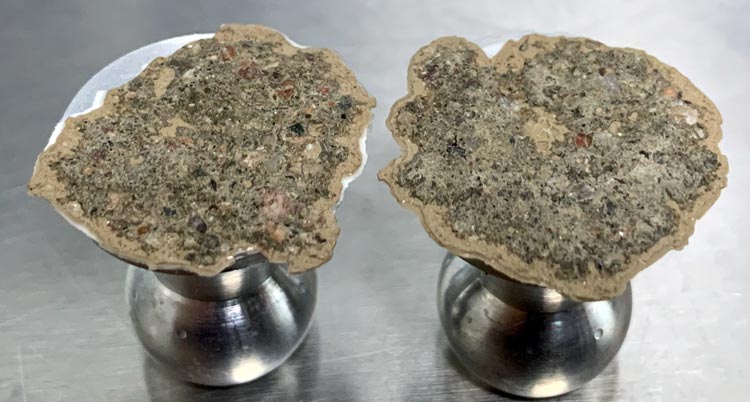
The third coating system, the lower left quadrant of the test square, consisted of a 100% solids solvent reducible epoxy primer, a 100% solids epoxy stain/chip coat, and a polyaspartic acid topcoat. The 100% solids epoxy primer system has an average adhesion peel strength of 925 psi. This is an excellent pullout value, approximately 185-231% higher than the typical tensile strength of concrete (400-500 psi), or 180.3% higher than a console car (513 psi). There are large pieces of concrete on the surface of the trolley, which is very rough and uneven, and the pull position shows that the residual coating is less than 10%. This would be considered a substrate failure. The tensile strength of this coating far exceeds that of concrete, and the penetration of the epoxy coating into the substrate actually strengthens it.
Polyaspartic Primer - 891 psi (glue fails)
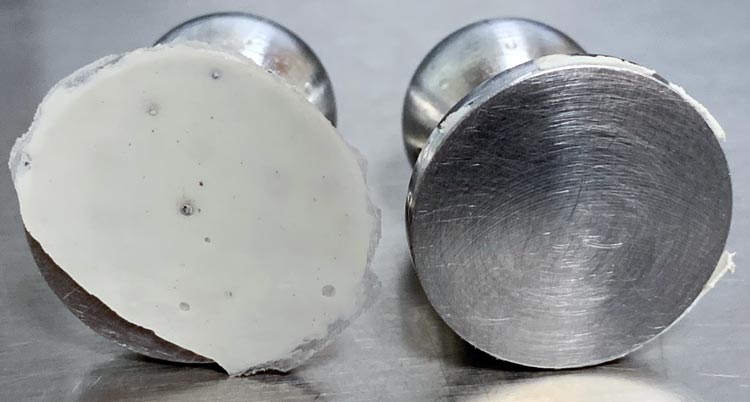
第四个涂层系统,即测试方块的右下象限,由 85% 固体聚天冬氨酸底漆、85% 固体聚天冬氨酸着色/切片涂层和聚天冬氨酸面漆组成。固体含量为 85% 的聚天冬氨酸底漆系统的平均粘附剥离强度为 891 psi。这是一个很好的拉拔值,比混凝土的典型抗拉强度 (400-500 psi) 大约高 178-222%,或比控制台车 (513 psi) 高 173.68%。一个小车表面显示 3M 粘合剂,另一个显示干净的小车表面,这是一个非常有趣的拉力,因为两个小车粘合剂都失败了。这将被认为是表面的涂层/胶水失效。失效时的拉断强度与过去两种涂层系统(WB环氧树脂和环氧树脂100)一致,并超过混凝土的抗拉强度。聚天冬氨酸涂层穿透基材的结果实际上强化了它,否则它会在 500 psi 左右更早失效。
看到这种类型的故障令人惊讶,因为它很少发生,并且很可能由于小车表面或胶水与小车或涂层之间的污染而导致粘合失败,我们可以看到每种情况都发生过。一个小车在胶水和涂层之间出现故障,另一个在小车和胶水之间出现故障。在失效时,该力还导致涂层在底漆和基材水平上从基材上拉出。它分别在 862 psi 和 920 psi 的两个拉力下发生。在仔细检查基材拉动位置并剥离涂层后,确定附着力脱落数将代表该样品,因为基材界面在初始拉动结束时已经轻微脱落。如果胶水没有失效,
酸的粘附剥离强度为 900 psi,可接受的结果可能会因所用基材的不同而有 10% 或更多的差异。例如,先前使用在当地五金店找到的混凝土块进行的基材测试导致读数高得多。像上图这样的混凝土砌块非常多孔,使涂层比通常在更典型的混凝土地板中渗透得更远。像这样的混凝土块的附着力测试可导致 1000-1500+ psi 范围内的拉断强度数。对多孔混凝土块进行测试会产生异常数量并在测试中引入偏差。不仅测试方法很重要,
结论:地坪涂料系统在附着力方面发挥着重要作用

This study aimed to evaluate the adhesion peel strength of different coating systems on concrete substrates. Choosing the right floor coating system does play a role in concrete adhesion. Instead, the solution is to choose the right primer. The first coat of a coating system can be important because it is the layer that bonds directly to the substrate. The acrylic sealer in this study was dry to the touch within 30 minutes and did not penetrate the concrete nearly as well as all the other systems in the study. The acrylic primer failed at an average pull-off strength of 321 psi, on average, 64.3% lower than the pull-off strength of the other three systems in the study.
While the adhesion test is not an indicator of how long the coating will survive, it is a good indicator of the overall quality of the flooring system. Comparative tests like this are useful because other systems in the study have been in use for decades on hundreds of thousands of floors. Slide-Lok's network of contractors installs tens of thousands of floors each year. Floor failures are rare; however, when they do occur, the vast majority can be attributed to applicator/mixing errors, improper substrate preparation, and/or water reduction issues. It goes without saying that it would be unwise to deliberately choose a primed coating system with an adhesion pull-off strength that is 64.3% lower than other coatings readily available today.
- 1Film adhesion detection method and its applicability analysis
- 2Purpose, method, principle and operation points of coating adhesion test
- 3Working principle and application of UV coating Cupping testing device
- 4Principle and Application Analysis of Film Adhesion Tester
- 5Optical inspection device Anti-reflection film adhesion Measuring method
- 6Automatic scratch test to evaluate film strength, hardness, adhesion
- 7Comparison of film adhesion determination methods
- 8Determination of film adhesion
- 9Paint film adhesion and test method thereof